

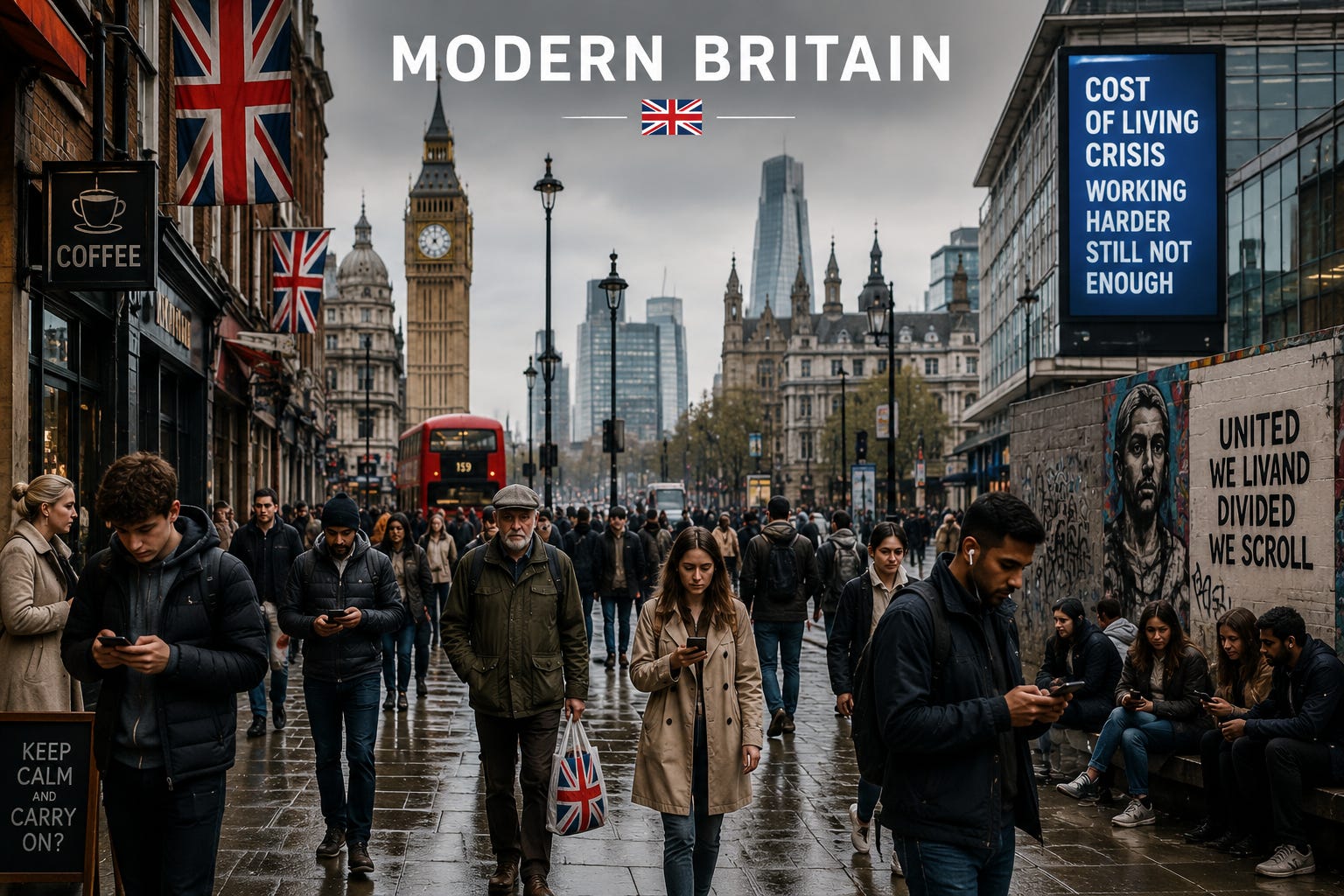
There is a quiet frustration growing across Britain.
You hear it in conversations with friends, former colleagues and people approaching retirement. You see it in news stories about artificial intelligence, automation and jobs disappearing. You sense it whenever someone says, “I don’t recognise the world anymore.”
The strange thing is that many of these people did exactly what society asked of them.
They studied hard.
They earned qualifications.
They found steady work.
They stayed loyal to employers.
They paid their taxes.
They saved for retirement.
They believed that if they worked hard enough, life would become more secure with each passing year.
For decades, that wasn’t an unreasonable belief.
Parents passed this advice to their children because it had worked for them. Teachers reinforced it. Governments encouraged it. Employers rewarded it.
It wasn’t just career advice.
It was a social contract.
Work hard today, and tomorrow will be better.
But somewhere along the way, that contract quietly changed.
Technology accelerated.
Global competition intensified.
Permanent jobs became temporary contracts.
Entire industries transformed.
Now artificial intelligence is beginning to perform work that once required years of education and experience.
Many people feel as though the ground beneath their feet has shifted.
Not because they made bad decisions.
Because they prepared for a future that no longer exists.
Perhaps the greatest misconception of the last fifty years was believing that education was something you finished.
You left school.
You earned a degree.
You found a career.
Then you simply became more experienced every year.
That model worked in a world where change happened slowly.
Today’s world is different.
Knowledge has a shorter lifespan.
Skills become outdated faster.
Entire professions evolve within a decade instead of a generation.
The people who thrive are often not the ones who know the most.
They’re the ones who keep learning.
That can be a difficult truth to accept, particularly if you’ve spent twenty or thirty years building expertise.
When your profession changes—or disappears—it doesn’t just threaten your income.
It challenges your identity.
If someone asked you who you were, many of us answered with our job title.
Teacher.
Engineer.
Nurse.
Manager.
Technician.
But what happens when that title no longer defines your place in the world?
For many people, especially later in life, this can feel like being left behind.
Yet perhaps we’re asking the wrong question.
Instead of asking whether we’re too old to change, maybe we should ask whether we’ve stopped giving ourselves permission to learn.
The mistake many people make is believing reinvention belongs to the young.
It doesn’t.
Reinvention belongs to the curious.
I’ve met people who discovered photography after retirement.
Others learned to write.
Some started businesses from their kitchen tables.
Others embraced artificial intelligence, digital publishing, filmmaking or design for the very first time.
They didn’t become younger.
They became students again.
I’m on that journey myself.
Retirement didn’t mark the end of learning.
It became the beginning of a different kind of education.
One driven not by exams or qualifications, but by curiosity.
Every new skill reminds me that growth doesn’t have an age limit.
Perhaps that’s the lesson our education system should have been teaching all along.
Not how to prepare for one career.
But how to prepare for a lifetime of change.
The future will belong to people who are prepared to become beginners more than once.
That doesn’t mean abandoning everything you’ve learned.
Quite the opposite.
Your experience, judgement and resilience remain enormously valuable.
The difference is that they now become the foundation on which you build something new.
Maybe you haven’t fallen behind.
Maybe the world simply changed direction.
And maybe the greatest advantage you can have isn’t knowing all the answers.
It’s still being willing to ask questions.
Because in an age where change has become the only constant, curiosity may be the most valuable qualification any of us can possess.
Next time: How to Reinvent Yourself When the Rules Have Changed—seven practical steps for navigating a world where learning never really ends.
If this article resonated with you, I’d love to hear your thoughts.
Have you ever reached a point where you realised the rules had changed? How did you respond?
Please share this article with someone who may be asking themselves the same question. Restack it if you’re reading on Substack, and subscribe for more reflections on work, technology and how we navigate a rapidly changing Britain together.