

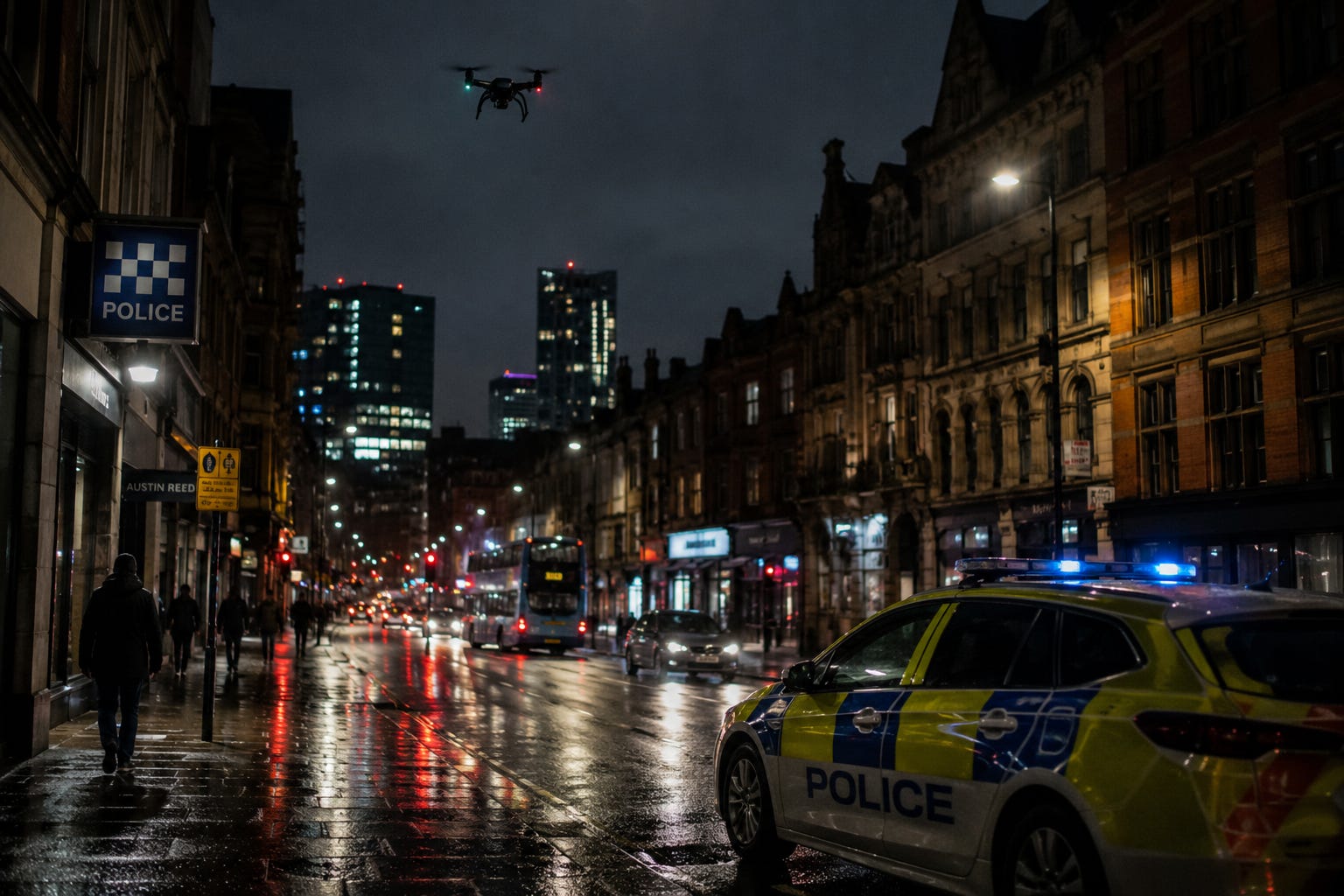
This article is an experiment in evidence-based speculative storytelling. The opening is fictional. Everything presented as reality is based on documented evidence. The sections looking towards 2027–2030 explore possible futures — they are not predictions.
Manchester, November 2029
It’s just after midnight.
A man leaves a tram stop and starts walking home.
Two people approach him. There is an argument.
One of them throws a punch.
Within seconds, an emergency call reports an assault. A drone stationed nearby is dispatched.
It doesn’t carry a weapon. It cannot make an arrest and doesn’t decide who is guilty.
It is simply an eye in the sky.
By the time the attackers start running, the drone is approaching. Its camera finds them.
They separate.
The drone follows one while police receive live pictures and location information.
A facial-recognition system produces a possible match against a police watchlist. A human operator checks it.
Officers intercept the suspect several streets away.
The incident has been recorded.
From the emergency call to locating the suspect, only minutes have passed.
There’s just one problem with this story.
It hasn’t happened.
Not like this.
Not yet.
But several of the technologies needed to make it possible already exist.
REALITY — 2026
The police are already above us
British police forces already use drones extensively.
According to the National Police Chiefs’ Council, UK police make around 60,000 drone flights each year. They are used for tasks including locating missing people, tracking offenders and giving officers an aerial view of developing incidents.
The NPCC says drones can help officers search large areas quickly while providing information to commanders on the ground.
Source: National Police Chiefs’ Council — Police use of drones
Police forces are also experimenting with something particularly relevant to our fictional assault: Drone as First Responder.
Norfolk Constabulary has led trials in which remotely stationed drones can be dispatched following an emergency call and transmit live footage back to a police control room, potentially giving officers information about what is happening before a conventional patrol arrives.
Source: National Police Chiefs’ Council — Drone as First Responder trials
The Metropolitan Police has gone further.
In July 2026, Commissioner Sir Mark Rowley said the Met’s programme had expanded from two drones to nine, with drones being deployed to around 200 incidents each week.
According to Rowley, their response time was approximately two minutes, compared with an average of nine minutes for response officers. That allows a drone, in some circumstances, to arrive first, provide live intelligence and potentially track suspects.
Source: Metropolitan Police — Commissioner’s speech on technology, July 2026
Kent Police has reported another practical example. Its drones were deployed to more than 1,100 calls during 2025 and helped locate 58 suspected criminals and 16 missing people.
Source: Kent Police
So the drone in our fictional Manchester assault isn’t the particularly futuristic part.
The more difficult question is what we eventually allow that drone to do.
The face in the crowd
Britain also already uses police facial recognition.
Live facial recognition compares people passing a camera against a predetermined police watchlist. Retrospective facial recognition can compare images obtained during an investigation with images already held by police.
These systems are not supposed to make autonomous decisions about guilt. Current policing guidance includes safeguards around watchlists, proportionality and human decision-making.
Source: College of Policing — Live Facial Recognition guidance
The technology is also expanding.
In June 2026, the Home Office announced £140 million of investment over three years in policing AI, including funding for 40 additional live facial-recognition units.
Source: Home Office — PoliceAI investment
None of this means police drones are currently flying around British cities automatically identifying everyone underneath them.
They aren’t.
But we already have some of the individual components: drones capable of rapidly reaching incidents, cameras capable of recording suspects, facial-recognition systems capable of comparing faces against watchlists, and AI increasingly being incorporated into policing.
The speculative question is what happens if those capabilities gradually become connected.
POSSIBLE FUTURE — 2027
The drone gets there first
Imagine Drone as First Responder trials prove useful and are expanded.
The government’s argument could be straightforward: the drone isn’t replacing the police officer. It’s getting there first.
Someone reports an assault outside a railway station. Instead of officers arriving several minutes later with limited information, a drone reaches the area quickly and gives the control room a live picture.
Perhaps the offender is still there. Perhaps they are running away. Perhaps the situation reported during the emergency call isn’t quite what officers expected.
The drone doesn’t decide what happened. It records what it can see, while humans retain responsibility for decisions.
For many people, that might be an easy bargain to accept.
If you were lying injured on the pavement, would you object to a police camera arriving before the police officer?
POSSIBLE FUTURE — 2028
Now give it another pair of eyes
Suppose the programme appears successful.
More cities introduce remotely stationed drones. Areas experiencing persistent violent crime receive greater coverage, while police argue that the technology allows limited human resources to be directed towards incidents where officers are actually required.
Then comes another proposal.
If a drone is already following somebody suspected of committing a serious assault, should police be able to check whether that person is already on a legitimate watchlist?
Perhaps they are wanted in connection with murder, rape or another serious violent offence.
The argument suddenly becomes harder because many members of the public may actually support it.
A Home Office survey published in December 2025 found 64% overall support for police use of facial-recognition technology.
Context mattered considerably. In areas described as having high levels of crime, 79% regarded live facial recognition as always or usually acceptable.
Source: Home Office — Public attitudes to police use of facial recognition technology, December 2025
That suggests an interesting public bargain.
We might be prepared to give police greater ability to watch public spaces if we believe that doing so increases their ability to find people who seriously harm others.
But how far does that bargain extend?
Beyond the Headlines
If you enjoy evidence-based stories exploring where today’s technology might take us next, you can subscribe free.
The aim isn’t to predict the future. It’s to investigate what’s happening now — and ask where it might lead.
POSSIBLE FUTURE — 2029
When being seen becomes the deterrent
Return to Manchester.
The assault happens. The drone arrives and the attackers run.
The camera follows while police receive their location. Facial recognition produces a possible match against an authorised watchlist, a human officer verifies it and officers on the ground make the arrest.
But something else has changed.
Potential offenders now know the system exists.
The deterrent isn’t necessarily the drone itself. It may be the perceived probability of being recorded, followed and identified.
Would someone be as willing to attack another person outside a railway station if they believed there was a high probability that police would obtain a continuous recording of their escape?
Perhaps.
Perhaps not.
We shouldn’t pretend the evidence gives us a simple answer. Surveillance doesn’t automatically prevent crime, and cameras cannot solve the complicated causes behind violence.
But imagine that recorded violent crime starts falling in areas covered by the system.
Residents begin demanding coverage.
One neighbourhood has rapid-response drones. The neighbouring one doesn’t.
People start asking their MPs:
Why aren’t we protected too?
Something introduced as an experiment gradually becomes an expectation.
POSSIBLE FUTURE — 2030
From observation to intervention
By 2030, imagine that seeing police drones over British cities is no longer remarkable.
Neither is facial recognition in certain circumstances.
The controversial proposal is now something different.
Robotic police support.
Not science-fiction machines independently deciding who should be arrested.
Something much more limited could arrive first: machines capable of remaining in particular locations for long periods, recording incidents, communicating with the public and summoning human officers.
Government might make much the same argument it previously made about drones:
This isn’t replacing police officers. It’s protecting them.
A machine could potentially approach a dangerous situation without immediately putting an officer’s life at risk. It could enter hazardous environments, maintain a presence for long periods and create a continuous record of interactions.
Eventually another question would inevitably appear.
If somebody is being seriously attacked immediately in front of such a machine, should it be allowed to intervene physically?
That is a very different proposition from a camera in the sky.
Yet we may have arrived there through a series of individually reasonable decisions.
What happens if it works?
Stories about surveillance technology often make the technology obviously sinister.
That’s the easy version of this story.
The harder version is that the system works.
Imagine assaults falling in areas where the technology operates. Imagine missing children being located faster, wanted offenders finding it harder to disappear and police officers receiving better information before entering dangerous situations.
Imagine people genuinely feeling safer walking home.
Then ask those people to give the technology back.
Would they?
Public attitudes towards facial recognition already hint at this tension.
The same Home Office research that found substantial support for police facial recognition also found significant concerns. Sixty-eight per cent were worried about misuse or hacking, 49% about false identification and 46% about losing control over information collected by police.
Source: Home Office — Public attitudes to police use of facial recognition technology
Those aren’t necessarily contradictory positions.
Someone can believe facial recognition could help police catch a violent offender while simultaneously worrying about what happens when the technology gets something wrong.
The real argument isn’t simply surveillance versus privacy.
It is whether society can obtain the benefits of increasingly powerful technology while maintaining meaningful limits on how that power can be used.
The other 2030
There is another possible future.
The cameras make mistakes. Someone is wrongly identified. Watchlists gradually expand.
Technology introduced to deal with murder, rape and serious violence begins being authorised for less serious offences. Systems introduced in particular high-crime locations spread into ordinary residential areas.
And infrastructure created by one government eventually passes to another government whose priorities may be very different.
At that point, the important question is no longer whether the technology works.
It is:
Who controls it?
That concern isn’t science fiction.
The government has already acknowledged that the existing legal framework surrounding police facial recognition is complicated and has consulted on a clearer framework covering facial recognition, biometrics and related technologies.
Source: Home Office — Consultation on a new legal framework for law-enforcement use of biometrics and facial recognition
The Biometrics and Surveillance Camera Commissioner has argued for safeguards including necessity, proportionality, transparency, accountability and lawfulness.
Source: Biometrics and Surveillance Camera Commissioner
Those principles could ultimately matter more than whether the next generation of drones can fly for two hours or twenty.
Because technology doesn’t decide the limits placed upon technology.
We do.
Where would you draw the line?
Forget 2030.
Imagine you’re walking home tonight.
Someone attacks you.
A police drone reaches the scene before an officer could. It records your attacker and follows them when they run.
A facial-recognition system produces a possible match indicating that the person may already be wanted for a serious violent offence. A human police officer verifies the identification.
Officers arrest them.
Would you object?
I suspect many people wouldn’t.
So make the question harder.
Would you accept drones routinely patrolling your neighbourhood if violent crime fell?
Would you accept facial recognition being attached to them?
Would you accept the system checking everyone it sees?
Would you allow an algorithm to decide that someone’s behaviour looked suspicious?
Would you eventually allow a machine to use physical force to protect someone from immediate serious injury?
Somewhere between those questions, most of us probably have a line.
We just won’t necessarily draw it in the same place.
Perhaps that’s the question we should be asking now rather than in 2030.
Because Britain doesn’t need to invent every component of this future.
Some of them already exist.
Reality, possibility and fiction
Documented reality: British police currently use drones and facial-recognition technology. Drone as First Responder programmes are being trialled, the Metropolitan Police has expanded its drone programme, and the government is investing further in policing AI and facial recognition.
Possible future: The events and developments described from 2027 to 2030 are fictional scenarios. They are neither government plans nor predictions that these events will occur.
The question: If these technologies continue improving, what powers should we permit them to have — and what safeguards should we demand before granting those powers?
Sources
National Police Chiefs’ Council — Police use of drones
National Police Chiefs’ Council — Drone as First Responder trials
Metropolitan Police — Commissioner’s speech on technology, July 2026
Kent Police — police drone deployments
College of Policing — Live Facial Recognition guidance
Home Office — PoliceAI investment
Home Office — Public attitudes to police use of facial recognition technology
Home Office — Consultation on a new legal framework for law-enforcement use of biometrics and facial recognition
Biometrics and Surveillance Camera Commissioner — response to facial-recognition consultation
Beyond the Headlines examines the mechanisms underneath today’s stories — and, in this experimental series, where today’s decisions might take us tomorrow.