

Image created by AI. The article uses AI in the editorial process
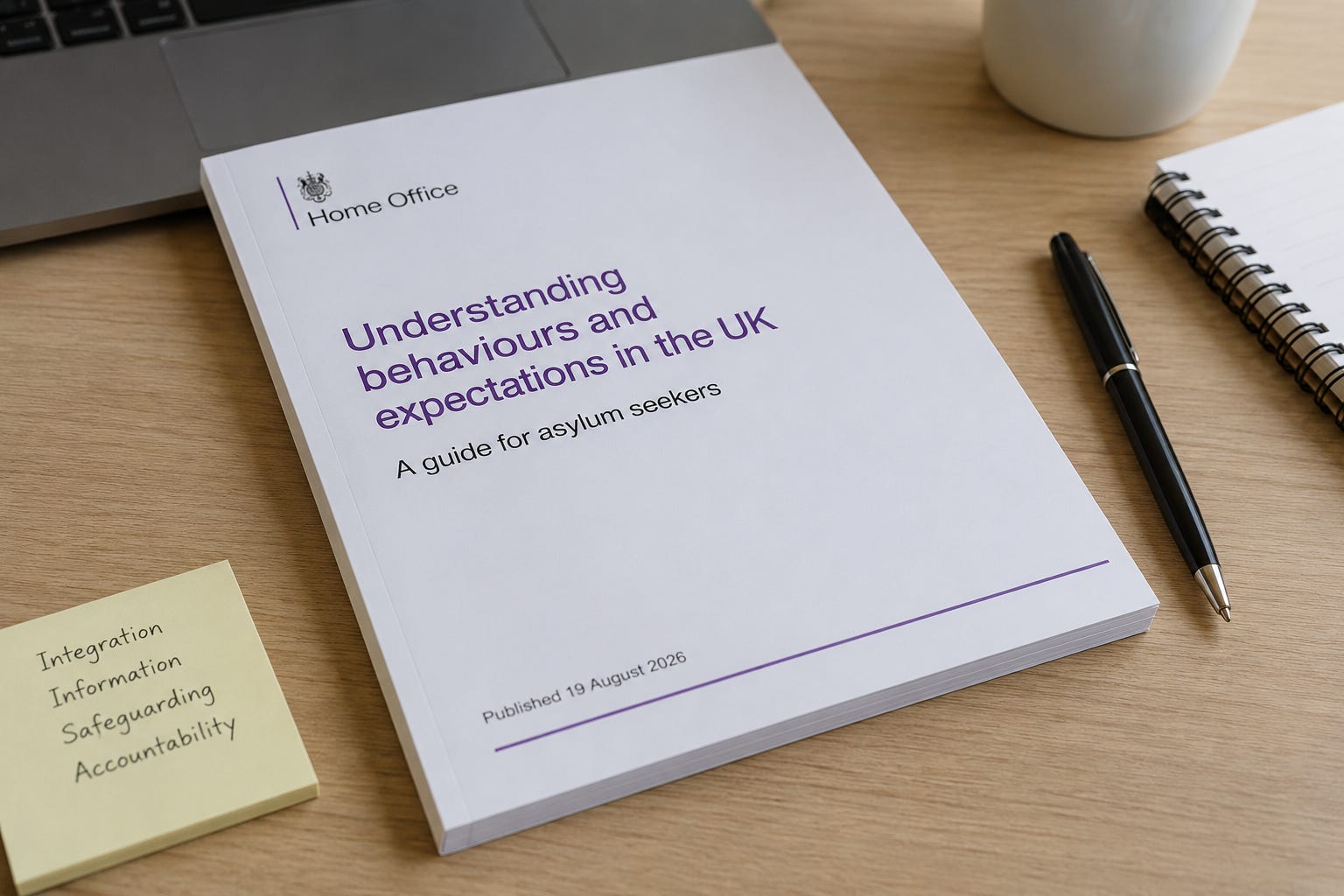
On 19 August, the Home Office published new guidance explaining behaviours and expectations to people seeking asylum in the UK.
The guidance covers gender equality, domestic abuse, sex and consent, behaviour in public and getting help.
The language is explicit.
Men and women have equal rights. Marriage does not remove the requirement for sexual consent. Sex without consent is rape. The age of consent is 16.
The Home Office also explains that laws and customs in Britain may differ from those in an asylum seeker’s home country.
My first reaction was straightforward:
If the Government believes this guidance is necessary, does it think there is a growing problem?
After looking at the evidence, I don’t think we can make that leap.
But trying to answer the question revealed something else worth examining.
The published national statistics cannot readily tell us whether asylum seekers are disproportionately represented among people prosecuted for sexual offences.
So rather than decide what the leaflet means before examining the evidence, let’s look at the strongest arguments from both directions.
🔵 THE LEFT-WING VIEW
This is preventative integration
There is a credible argument that we’re reading too much into the guidance.
People seeking asylum arrive in Britain from different countries, cultures and legal systems. Some British laws and social expectations will inevitably differ from those they have previously encountered.
The Home Office itself makes that point.
It also explicitly says that the rules and expectations in the guidance are not just for asylum seekers — they apply to everyone living here.
Explaining those expectations is therefore a reasonable part of integration.
There is nothing unusual about preventative education. Schools teach consent. Employers provide sexual-harassment training. Governments run campaigns about domestic abuse.
We don’t conclude that everyone receiving that information is likely to commit an offence.
Why should we apply a different standard to asylum seekers?
There is also an important danger in moving from individual crimes to assumptions about an entire population.
An asylum seeker who commits a sexual offence should be investigated and prosecuted where the evidence supports it.
But one person’s crime does not tell us how another person with the same immigration status will behave.
From this perspective, the guidance isn’t an admission of an asylum-seeker crime problem.
It is preventative integration.
🔴 THE RIGHT-WING VIEW
Why these particular messages?
There is another reasonable interpretation.
The Government hasn’t limited its guidance to practical information about living in Britain.
It has chosen explicitly to discuss gender equality, controlling behaviour, domestic abuse, sexual consent, rape, the age of consent and harassment.
That invites an obvious question:
Why did officials decide these subjects required explicit attention?
Countries around the world have different laws and social norms concerning marriage, women’s rights, sexuality, religion and individual freedom.
Recognising those differences does not mean everyone from a particular country holds the same beliefs.
Nor does it establish that they are more likely to commit crimes.
But integration shouldn’t require us to pretend meaningful cultural differences don’t exist either.
If government believes some of those differences warrant explicit education, voters are entitled to understand the reasoning.
Was this simply preventative integration?
Were there safeguarding concerns?
Did operational experience influence the decision?
Were particular incidents considered?
Or is this something ministers believe should always have been provided?
We shouldn’t invent the answer.
The Government should explain it.
⚖️ THE BALANCED VIEW
The guidance doesn’t prove either case
The existence of this guidance does not demonstrate that asylum seekers commit sexual offences at a higher rate than the wider population.
It doesn’t demonstrate that sexual offending among asylum seekers is increasing either.
Those are statistical claims requiring evidence.
And this is where the story becomes more interesting.
In September 2025, the Ministry of Justice was asked how many asylum seekers had been prosecuted for sexual offences during the previous year.
Its response said that while prosecution figures for sexual offences are published:
“Data held centrally does not include if a defendant was an asylum seeker or where they were housed.”
The Office for National Statistics has subsequently been asked for crime statistics broken down by immigration status.
Its response was similarly clear:
“We do not hold breakdowns of crime by asylum seeker or migrant status.”
That doesn’t mean no government organisation possesses potentially relevant information.
Nor does it mean producing reliable statistics would necessarily be straightforward.
But it does mean the publicly available national statistics cannot readily settle one of the most contentious arguments surrounding asylum and crime.
That should concern both sides.
Beyond the Headlines doesn’t ask you to choose a side before you’ve seen the evidence.
Each article examines competing arguments, tests them against what we can establish, then tells you what I think.
Subscribe free if you’d like to continue the conversation.
Missing data cuts both ways
Suppose reliable evidence demonstrated that asylum seekers were not disproportionately represented among people convicted of particular sexual offences.
That would matter.
It could challenge misinformation and help prevent crimes committed by individuals being attributed to thousands of innocent people.
Now suppose reliable evidence demonstrated disproportionate representation.
That would matter too.
Government could investigate possible causes, identify risk factors and decide whether different safeguarding or integration policies were necessary.
But even those statistics would require care.
Simply counting defendants who were asylum seekers wouldn’t establish disproportionate offending.
Meaningful comparisons would require appropriate population figures and consideration of factors such as age and sex.
Statistics can mislead just as easily as headlines when comparisons aren’t made properly.
There is another danger worth acknowledging.
Repeatedly placing the words asylum seeker and rape together can itself create an association in people’s minds that the evidence doesn’t establish.
That is precisely why evidence matters.
We shouldn’t avoid legitimate questions because they are uncomfortable.
But we should be exceptionally careful about the conclusions we attach to them.
What information does the Government have?
When somebody claims asylum in Britain, the Home Office creates an individual record.
Its operational guidance says screening includes fingerprints, facial images and mandatory security and identity checks intended to establish the claimant’s identity as far as possible and biometrically link that person to the biographical identity provided.
Those words — as far as possible — matter.
This doesn’t mean the Government has conclusively verified the true identity or nationality of every asylum seeker.
People may arrive without reliable documents, and identities can be disputed.
But government nevertheless holds substantial individual information about asylum applicants.
Read the Home Office screening guidance
So there is a legitimate policy question:
Could appropriately protected and anonymised asylum and criminal-justice data be linked to produce reliable aggregate statistics?
Perhaps it could.
Perhaps legal, technical, privacy, proportionality or statistical considerations make that difficult or undesirable.
If so, explain them.
The absence of published statistics should not itself be treated as evidence that government is deliberately hiding information.
But the information gap is real, and it leaves space for competing claims that are difficult for the public to test.
What does this cost?
Then there is the less dramatic but important question of money.
Government guidance costs money to develop. Translation, printing, distribution and updating may cost money too.
I haven’t found a reliable published figure for what this particular intervention cost.
So I’m not going to suggest it was expensive or wasteful.
It might turn out to be extremely inexpensive.
And if a relatively cheap intervention helps somebody understand British law, improves integration or prevents serious harm, it could represent excellent value.
But taxpayers are still entitled to ask:
What did it cost?
How much was spent developing the material?
What are the translation costs?
How many languages will be supported?
How is it being distributed?
What ongoing costs are expected?
Scrutiny should be proportionate to the amount involved, but the principle remains the same.
Public money should have a public purpose.
And how will we know whether it works?
This may be the most important question of all.
What is the objective?
If the aim is simply to ensure asylum seekers have been given information about British law, distributing the material might satisfy that objective.
But if the intention is to change behaviour, improve integration or prevent abuse and offending, evaluation becomes considerably more important.
What outcome does government expect?
And how will it know whether that outcome has been achieved?
Otherwise we risk introducing policies because they appear sensible without discovering whether they actually work.
Three questions for Government
After looking at the issue from left, right and centre, I think the Government should answer three straightforward questions.
1. What is the evidence?
Why was this intervention introduced?
Was it routine integration policy, a response to particular concerns, or some combination of the two?
2. What does it cost?
What are the development, translation, distribution and ongoing costs?
The amount may be small.
Tell us.
3. What does success look like?
What is the policy intended to achieve, and how will government determine whether it has worked?
These questions don’t assume the policy is wrong.
They are how we determine whether it is right.
What I Think
I started this article with a suspicion.
If the Government believes asylum seekers need explicit guidance about rape, consent and women’s rights, perhaps it knows there is a growing problem.
After examining the available evidence, I can’t substantiate that conclusion.
So I won’t make it.
What we can say is that the Home Office considers these subjects important enough to address explicitly with asylum seekers.
What we don’t yet know is precisely why.
And the published national statistics don’t allow us confidently to determine whether asylum seekers are disproportionately represented among people prosecuted for sexual offences.
For me, that makes transparency more important, not less.
If this is simply sensible preventative integration, explain the reasoning.
If evidence points towards a particular safeguarding concern, explain that too.
If government doesn’t have sufficient information to know, acknowledge the gap and examine whether reliable statistics can lawfully and proportionately be produced.
And tell taxpayers what the intervention costs and how its effectiveness will be assessed.
There is nothing inherently anti-immigration about asking those questions.
Nor does asking them require us to assume asylum seekers are criminals.
They are questions about government accountability.
Whenever government identifies a problem, intervenes and spends public money, voters should be able to ask:
Why are you doing this? What evidence supports it? What does it cost? And did it work?
Those questions should apply whether we’re discussing immigration, the NHS, defence, education or anything else.
Because accountability shouldn’t depend on whether we happen to agree with the policy.
Government doesn’t owe voters the answer they want to hear.
It owes them an explanation.
Sources
Home Office, 19 August 2026: Understanding behaviours and expectations in the UK: a guide for asylum seekers.
UK Parliament, Written Question 71678: Ministry of Justice response concerning asylum seekers and sexual-offence prosecutions.
Office for National Statistics: Crime by nationality and immigration status 2025.
Home Office: Asylum screening and routing operational guidance.
About this format
This is a new Beyond the Headlines format.
Instead of starting with a political position and defending it, I present a credible Left View, Right View and Balanced View, test those arguments against the available evidence, and then tell you what I think.
The labels describe arguments, not everyone associated with a political tradition. Reasonable people on either side may disagree with them.
Criminal responsibility belongs to individuals and should be established by evidence. Nothing in this article attributes the criminal behaviour of individual offenders to asylum seekers collectively.
If you disagree with my conclusion, that’s fine. The point isn’t to tell you what to think. It’s to give you enough information to think about it for yourself.