

One day, almost every one of us will need help.
Not because we have failed.
Not because we have done something wrong.
But because, if we are fortunate enough to live a long life, age eventually changes all of us.
The question is not if that day comes.
The question is:
Who will look after us?
It is one of the most important questions of the twenty-first century, yet it is discussed surprisingly little.
Whether you live in Britain, the United States, Canada, Spain, Australia, Japan or almost any other developed nation, the same reality is emerging.
We are living longer than ever before.
And that changes everything.
The greatest success with an unexpected consequence
For thousands of years, reaching old age was a privilege enjoyed by relatively few.
Today, millions of people can expect to live well into their eighties and beyond.
This is one of humanity’s greatest achievements.
Better healthcare.
Better nutrition.
Safer workplaces.
Medical advances.
We should celebrate that success.
But every success creates new challenges.
Longer lives mean more people living with chronic illness.
More people needing care.
More people living alone.
More years spent in retirement.
Societies across the world were never designed for this scale of longevity.
The family has changed
For generations, families often cared for older relatives.
Several generations lived close together.
Children grew up knowing their grandparents.
Neighbours looked in on one another.
That world still exists in many places, but it is becoming less common.
Children move away for work.
Families are smaller.
Many people never have children.
Relationships change.
Communities become more fragmented.
Love between families has not disappeared.
Distance has increased.
And distance makes care more difficult.
The silent epidemic
Many people fear illness.
Many fear dementia.
Many fear losing their independence.
But ask older people what worries them most, and another answer often appears.
Being alone.
Loneliness is rarely dramatic.
It arrives quietly.
The conversations become less frequent.
The telephone rings less often.
Friends become fewer.
Partners die.
Mobility becomes more difficult.
Days become quieter.
It is possible to be surrounded by millions of people and still feel invisible.
Can governments solve this?
Governments play an essential role.
Healthcare.
Social care.
Housing.
Transport.
Public spaces.
All of these matter.
But governments alone cannot create belonging.
No government programme can replace genuine friendship.
No policy can manufacture neighbours who know one another.
No budget can guarantee kindness.
Governments can provide services.
Communities provide connection.
We need both.
Will technology become our carer?
Artificial intelligence is already beginning to transform healthcare.
Wearable devices can monitor heart rhythms.
Smart homes can detect falls.
Robots are being developed to assist with daily living.
Virtual assistants can remind people to take medication or attend appointments.
These innovations will become increasingly important.
But technology should never become an excuse to reduce human contact.
A robot may help someone stand.
It cannot share a lifetime of memories.
An AI assistant may answer questions.
It cannot replace the comfort of someone who genuinely cares.
Technology should support human relationships.
Not replace them.
Perhaps retirement needs a new purpose
For much of the last century, retirement meant stopping.
Stopping work.
Slowing down.
Taking life easier.
That idea no longer feels sufficient.
Many people now spend twenty or even thirty years in retirement.
That is an entire chapter of life.
Perhaps retirement should become a period of contribution rather than withdrawal.
Mentoring younger people.
Volunteering.
Creating art.
Learning new skills.
Supporting local communities.
Starting businesses.
Sharing experience.
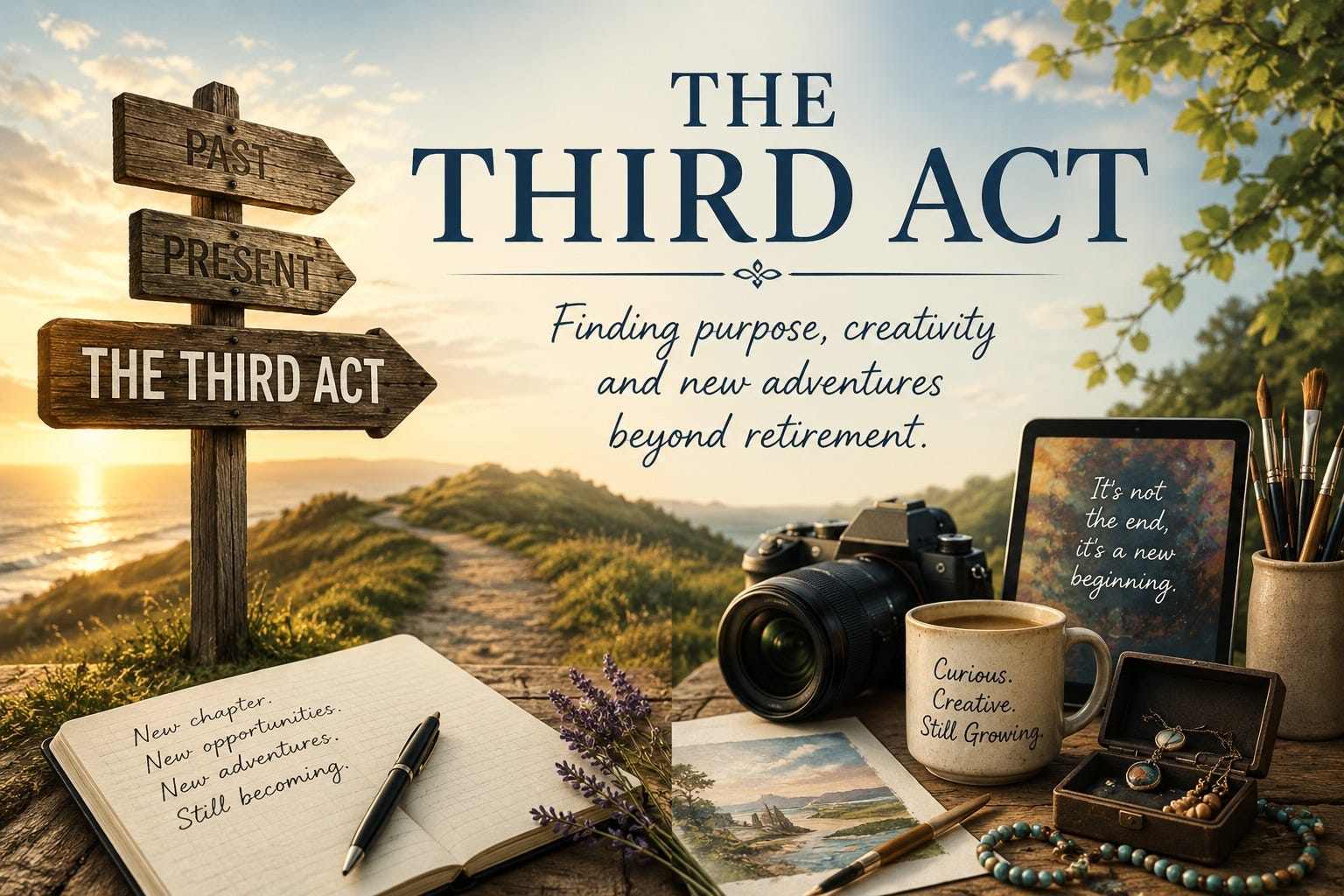
The Third Act should not be defined by what we stop doing.
It should be defined by what we choose to become.
A global challenge
Ageing populations are no longer unique to one country.
Japan faces them.
Italy faces them.
Spain faces them.
Canada faces them.
Australia faces them.
The United States faces them.
Britain faces them.
The details differ.
The challenge is shared.
Every nation is searching for answers.
Some invest heavily in technology.
Others focus on healthcare.
Others rely more on families and communities.
Perhaps the greatest opportunity lies in learning from one another rather than assuming there is only one solution.
Maybe we are asking the wrong question
Perhaps the question is not:
Who will look after us?
Perhaps it is:
What kind of society do we want to become before we need looking after?
A society where older people remain visible.
Where experience is respected.
Where neighbours know one another.
Where technology supports humanity rather than replacing it.
Where ageing is seen not as a burden, but as another stage of life with meaning, purpose and value.
The Third Act
One day, every one of us will leave work for the final time.
None of us knows what the years beyond that moment will bring.
What we do know is this.
The world is changing.
People are living longer.
Communities are changing.
Technology is advancing.
The question of who will care for us is becoming more urgent with every passing year.
Perhaps the answer will never come from governments alone.
Or from technology alone.
Or even from families alone.
Perhaps the answer begins with recognising that every one of us has a part to play in building the kind of communities we hope will one day care for us in return.
Because the question isn’t simply:
Who will look after us?
It’s whether we are building a world where no one has to grow old feeling forgotten.
Join the conversation
This is one of the biggest questions facing societies around the world.
How is your country preparing for an ageing population?
What is it getting right?
What still concerns you?
Whether you’re reading from Britain, Canada, Australia, Spain, the United States, or anywhere else, I’d genuinely like to hear your perspective.
If this article made you stop and think, please consider sharing it. The more experiences we hear from around the world, the better we can understand the opportunities—and the challenges—of the third act of life. 🌍