

The argument in 60 seconds
Don’t have time for the full article? Here’s the argument.
The wildfire danger was real, and using an Emergency Alert was a defensible decision.
But good public communication isn’t only about whether a message is correct. It also needs to anticipate what people are likely to do after receiving it.
After the alert, fire services had to remind people not to call 999 simply because they saw someone using a barbecue or lighting a bonfire.
Research suggests that the frequency, relevance and content of emergency warnings can contribute to warning fatigue, potentially reducing their effectiveness.
Expertise matters, but so does frontline experience. The people who deal with the consequences can often spot problems that aren’t obvious on paper.
Before a major announcement, government should stress-test the message: What is actually likely to happen when this meets the real world?
The lesson isn’t to stop warning people. It’s to protect the credibility of important warnings by thinking beyond the moment the message is sent.
The bigger question: Should government sometimes say less, a little later — but say it properly?
On Friday evening, millions of phones across England and Wales suddenly made that unmistakable noise.
An Emergency Alert.
The reason was serious. Britain was experiencing exceptional heat and drought; firefighters were dealing with major wildfires, homes had been damaged or destroyed, and emergency services were under considerable pressure.
The government wanted people to stop doing things that might start another fire.
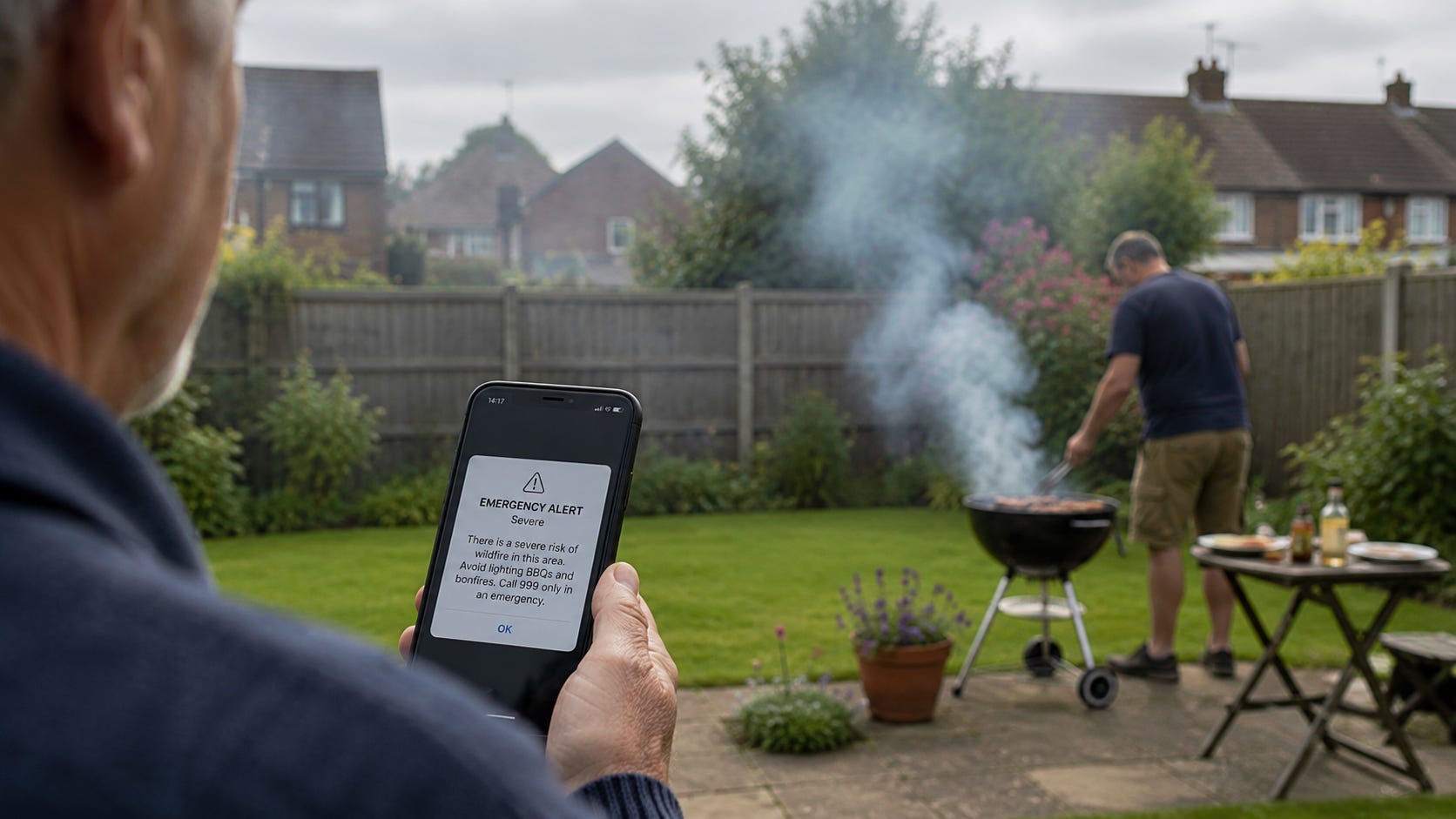
The message warned against barbecues, campfires, fireworks and anything else that could spark a blaze. It also told people to report fires immediately by calling 999.
There was nothing unreasonable about the objective.
Then came an unintended consequence.
Fire services had to ask people not to call 999 simply because they saw neighbours using barbecues or lighting bonfires unless there was a genuine emergency.
That doesn’t prove the alert was a mistake.
But it raises a question worth asking:
When government communicates with millions of people, is it enough for the message to be correct — or should it also consider what people are likely to do because they’ve received it?
First, the government had a point
It’s easy to criticise an emergency warning from the comfort of a home that isn’t on fire.
The wildfire threat was real.
By 14 August, the number of wildfires recorded in England and Wales during 2026 had already exceeded the previous annual record. Homes had burned, people had been evacuated, and emergency services were under considerable pressure.
The government was also using the Emergency Alerts system for something it was designed to address: a serious threat to life.
Not everybody watches television news, reads newspapers, follows government accounts online or checks weather warnings. An Emergency Alert can put important information directly onto millions of phones within minutes.
If that message prevented another wildfire, protected a home or stopped somebody being injured, ministers could reasonably argue that an intrusive alarm was justified.
That’s the strongest argument for sending it.
And it deserves to be taken seriously.
But accepting the danger doesn’t mean we shouldn’t examine the communication.
What did we expect people to do next?
Imagine receiving the alert.
Your phone makes an alarming noise. You’re told there is a serious wildfire risk. You’re warned not to light anything that could start a fire and told to call 999 if you spot one.
Later, you look outside.
There’s smoke.
Your neighbour has lit a barbecue.
What do you do?
Some people will look at it, decide there’s no immediate danger and carry on with their evening.
Someone else may think:
I’ve just received an emergency warning about fire. I’m not taking any chances.
And they call 999.
We could dismiss that person for lacking common sense.
But perhaps common sense works both ways.
If you’re sending an alarming message to millions of people, shouldn’t somebody ask beforehand:
What are people actually likely to do when they receive this?
Not what we want them to do.
What will they actually do?
The Boy Who Cried Wolf
Most of us know the story.
The boy repeatedly raises the alarm. Eventually people stop responding.
Then the wolf actually arrives.
It has survived for centuries because it describes something recognisably human: warnings can lose their impact when people become accustomed to them.
Modern research has a rather less memorable name for something related to this:
Warning fatigue.
Peer-reviewed research published in the Journal of Contingencies and Crisis Management in 2025 examined over-alerting and warning fatigue in wireless emergency alert systems.
The researchers found that factors including frequency, relevance and message content can contribute to warning fatigue and potentially to people disengaging from alerts.
That does not mean this particular British wildfire alert will cause people to ignore a future emergency.
We don’t have evidence for that, and it would be wrong to pretend that we do.
But maintaining the significance and credibility of emergency warnings matters.
The government’s own research provides another interesting piece of the picture.
In its 2025 survey of more than 10,000 people, 29% of mobile-phone users said they had received a genuine Emergency Alert during the previous year.
Among those who said they had received one, 53% reported acting on the advice.
Thirty-eight per cent said they hadn’t.
Getting a warning onto someone’s phone doesn’t guarantee the desired response.
How people interpret the message matters too.
Enjoying Beyond the Headlines?
I write about the questions underneath the announcement — without telling you what you’re supposed to think.
Subscribe for free to join the conversation.
Perhaps this is where common sense comes in
I’m wary of the phrase common sense.
It’s frequently used to mean:
This seems obvious to me, therefore everybody else must be wrong.
That’s not good enough for public policy.
We need evidence and professional expertise.
But we also need experience.
A firefighter understands fire behaviour.
A behavioural specialist can understand how people respond to warnings.
A 999 call handler knows the kinds of messages that generate calls.
Someone who has spent decades dealing with the public may recognise a reaction that looks completely obvious in hindsight.
None of those perspectives should automatically overrule the others.
Bring them together.
Then ask the embarrassingly simple question:
What happens when this meets the real world?
That is what I mean by applying common sense.
Not replacing expertise.
Stress-testing it against human behaviour.
Could the message have been better?
Perhaps the answer is no.
Perhaps the wildfire danger was serious enough that the government was absolutely right to use the Emergency Alerts system exactly as it did.
That’s a perfectly defensible position.
But we can still ask whether the communication could have been improved.
Could the distinction between seeing an actual uncontrolled fire and merely seeing somebody using a barbecue have been made clearer?
Could the message have anticipated unnecessary 999 calls?
Could emergency services have been better prepared for the public response?
Or was the additional demand simply an acceptable consequence of getting an urgent warning to millions of people?
I don’t know the answer.
But those are precisely the questions I want somebody asking before the message is sent.
Not left. Not right. Practical.
Government decisions inevitably contain politics.
A government has been elected to make decisions. Sometimes those decisions will be unpopular. Sometimes experts will disagree. Sometimes the public will disagree.
I’m not suggesting government should conduct an opinion poll every time it needs to act.
Nor should difficult decisions be abandoned simply because somebody objects to them.
But major communications and policies should be challenged before they reach us.
Bring in the experts.
Bring in the professionals who will have to implement them.
Listen to businesses and organisations affected by them.
Listen to frontline workers.
And don’t dismiss accumulated experience simply because the person providing it doesn’t have a policy qualification.
Older people can have something particularly valuable here: not automatic wisdom, but decades of seeing decisions made, consequences unfold and supposedly new ideas come around for another turn.
Younger people bring another perspective entirely.
And when politics is involved, deliberately find credible people who disagree.
Not because left and right can somehow be removed from politics.
They can’t.
But assumptions can be challenged.
Think beyond the announcement
Perhaps there’s a simple sequence worth considering.
Start with the evidence.
Bring in expertise.
Add experience from people who deal with the consequences in the real world.
Invite challenge from people who don’t already agree.
Then apply the common-sense test:
What is actually likely to happen when we do this?
Only then communicate.
The wildfire alert gives us a small but revealing example.
The danger was real.
The government’s intention was reasonable.
The warning may have prevented fires that otherwise would have happened. We’ll never know.
But the communication also produced a response significant enough for emergency services to remind people when not to call 999.
Both things can be true.
That’s important because public debate increasingly seems to demand that we choose one side.
Either the government was right or it was wrong.
Either the public behaved sensibly or stupidly.
Reality is usually messier.
Say less, later — but say it properly
I don’t want government to stop warning me.
Quite the opposite.
If my phone makes that distinctive noise because a flood is approaching, a wildfire threatens my community or another serious danger requires immediate action, I want to pay attention.
That’s precisely why the Emergency Alerts system matters.
And precisely why its use deserves careful thought.
So perhaps the lesson isn’t:
Stop sending alerts.
It’s:
Think beyond the alert.
Ask how people are likely to interpret it.
Ask what behaviour it might produce.
Ask the people who deal with those consequences every day.
Challenge the assumptions.
And then, after all the expertise and evidence, ask one final, ordinary question:
Does this make sense in the real world?
Sometimes government needs to communicate immediately.
Sometimes it needs to say something unpopular.
And sometimes perhaps it should say less, a little later — but say it properly.
Because the consequences of a government announcement don’t end when somebody presses Send.
That’s when they begin.
Sources & further reading
UK Government — Emergency Alert, 14 August 2026
Official announcement explaining the wildfire risk, use of the Emergency Alerts system and advice given to the public.
Reuters — UK wildfires, 14 August 2026
Independent reporting on the scale of the wildfires, evacuations, damaged homes and pressure on emergency services.
UK Public Survey of Risk Perception, Resilience and Preparedness 2025
Government research involving 10,536 respondents, including public awareness of and responses to Emergency Alerts.
Sutton & Wood (2025), Journal of Contingencies and Crisis Management
Peer-reviewed research examining over-alerting and warning fatigue in wireless emergency alert systems.
Beyond the Headlines is about looking past the announcement, questioning assumptions and examining what happens next.
I won’t tell you what to think. I’ll give you something worth thinking about.
If you’d like more, subscribe for free to Beyond the Headlines.