

The argument in 60 seconds
Don’t have time for the full article? Here’s the argument.
Britain can welcome immigration and cultural diversity while still expecting effective border management, integration and respect for the law.
Immigration isn’t one issue. Legal and illegal immigration are different. Religion and religious extremism are different. Integration and assimilation are different.
People shouldn’t have to abandon their culture, religion or identity to belong in Britain.
But a diverse democracy needs some shared civic principles: equality before the law, freedom of expression and religion, representative democracy, equal dignity for women and men, and respect for the rule of law.
Concerns about immigration and integration shouldn’t automatically be dismissed as prejudice. Equally, those concerns should never become an excuse to stereotype individuals or entire communities.
Government has a responsibility to apply laws fairly, support integration and maintain public confidence in institutions.
There are legitimate disagreements about the balance between effective enforcement and strong legal safeguards.
My argument isn’t that different cultures cannot live together. History shows that they can. The question is what principles we all need to share for that diversity to work.
The full argument and counterarguments are below. ↓
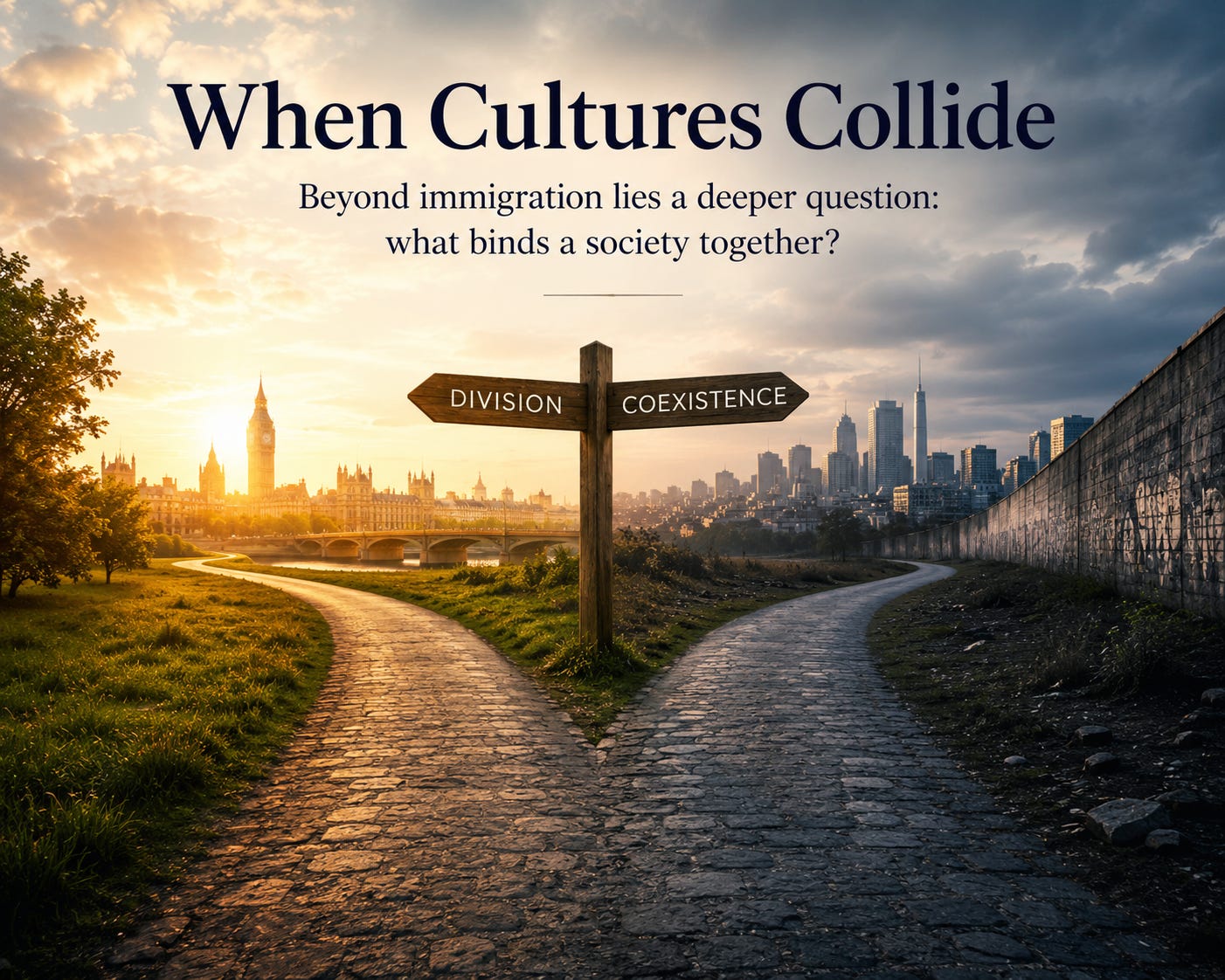
Can a democratic society remain both open and united when the people who live within it no longer share the same assumptions about law, culture and civic values?
Every generation inherits a country.
It also reshapes it.
Britain has never stood still. Throughout its history it has welcomed people from around the world. New ideas, new traditions and new communities have all become part of the nation’s story.
For many people this has been a success.
Millions have arrived legally, built businesses, raised families, contributed to their communities and proudly call Britain home.
That deserves recognition.
Yet every period of significant change eventually raises a difficult question.
What happens when cultures meet, but their expectations of society are fundamentally different?
This is where public debate often begins to fail.
Almost immediately people are expected to choose a side.
One side argues that raising concerns about immigration or integration risks encouraging prejudice.
The other argues that immigration itself is the problem.
Neither position fully explains the reality.
A society can welcome legal immigration while expecting its borders to be managed effectively.
It can celebrate cultural diversity while believing that everyone should respect the same laws.
It can protect individual rights while recognising that public confidence in those rights also matters.
These ideas are not contradictory.
They are part of the same democratic conversation.
One of the biggest mistakes we make is treating every aspect of migration as though it were one issue.
It is not.
Legal immigration is different from illegal immigration.
Religious belief is different from religious extremism.
Government policy is different from the people who live under it.
Integration is different from assimilation.
When these distinctions disappear, meaningful discussion disappears with them.
Perhaps the most important question is not about immigration at all.
It is about shared civic values.
Every successful democracy depends upon principles that apply equally to everyone.
Equality before the law.
Freedom of expression.
Freedom of religion.
Representative democracy.
Equal dignity for women and men.
Respect for the rule of law.
People may arrive with different histories, cultures and beliefs.
They do not need to abandon those identities.
But they do need to accept the civic principles that allow millions of strangers to live peacefully together.
When people believe those principles are becoming uncertain, public confidence begins to weaken.
That concern can take many forms.
Some people worry that immigration laws are not applied consistently.
Others question whether integration has been planned effectively.
Some women speak about feeling less safe in communities that have changed rapidly.
Others argue that such concerns are exaggerated or risk unfairly judging entire groups.
These perspectives should not be dismissed simply because they are uncomfortable.
Nor should they become reasons to stereotype people who have done nothing wrong.
Individuals should always be judged by their own actions.
Governments carry a unique responsibility in maintaining that trust.
Their role is not only to decide who may enter a country.
It is to ensure that laws are applied fairly, that integration is supported, that communities have confidence in public institutions and that everyone understands both their rights and their responsibilities.
Many people believe public confidence is weakened when enforcement appears inconsistent or legal processes become so lengthy that they no longer appear effective.
Others believe strong legal safeguards remain essential, even when they make decision-making slower and more complex.
Reasonable people can disagree about where that balance should be struck.
That disagreement is not a weakness.
It is part of democracy itself.
The greater danger comes when difficult questions can no longer be discussed without people immediately assuming bad faith.
If every concern is dismissed as prejudice, trust declines.
If every migrant is viewed with suspicion, trust also declines.
Neither approach strengthens society.
Healthy democracies ask difficult questions because they understand that silence rarely resolves tension.
It merely postpones it.
Perhaps, then, the question is not whether cultures can live together.
History suggests they can.
The real question is whether everyone—newcomers and those whose families have lived here for generations alike—is prepared to uphold the shared civic values that allow one society to exist.
Because without shared principles…
A shared future becomes much harder to build.
What do you think?
Can a modern democracy remain both open and cohesive? What shared civic values do you believe are essential if people from different cultures and backgrounds are to build one successful society together?
📝 Editorial Note
Every article in World Beyond the Headlines is written and reviewed in accordance with The Third Act Editorial Charter. Our goal is not to tell readers what to think, but to encourage thoughtful discussion through fairness, careful observation and respect for differing perspectives. We believe difficult questions deserve careful thought, respectful disagreement and an honest examination of the principles beneath the headlines.
If this article resonated with you
If you found this article thought-provoking:
Share it with someone who values thoughtful discussion.
Leave a comment—agreement isn’t required, but respectful conversation is always welcome.
Subscribe to The Third Act (it’s free) to receive future essays exploring the questions that shape modern life, along with practical guidance, original fiction and conversations designed to look beyond the headlines.