

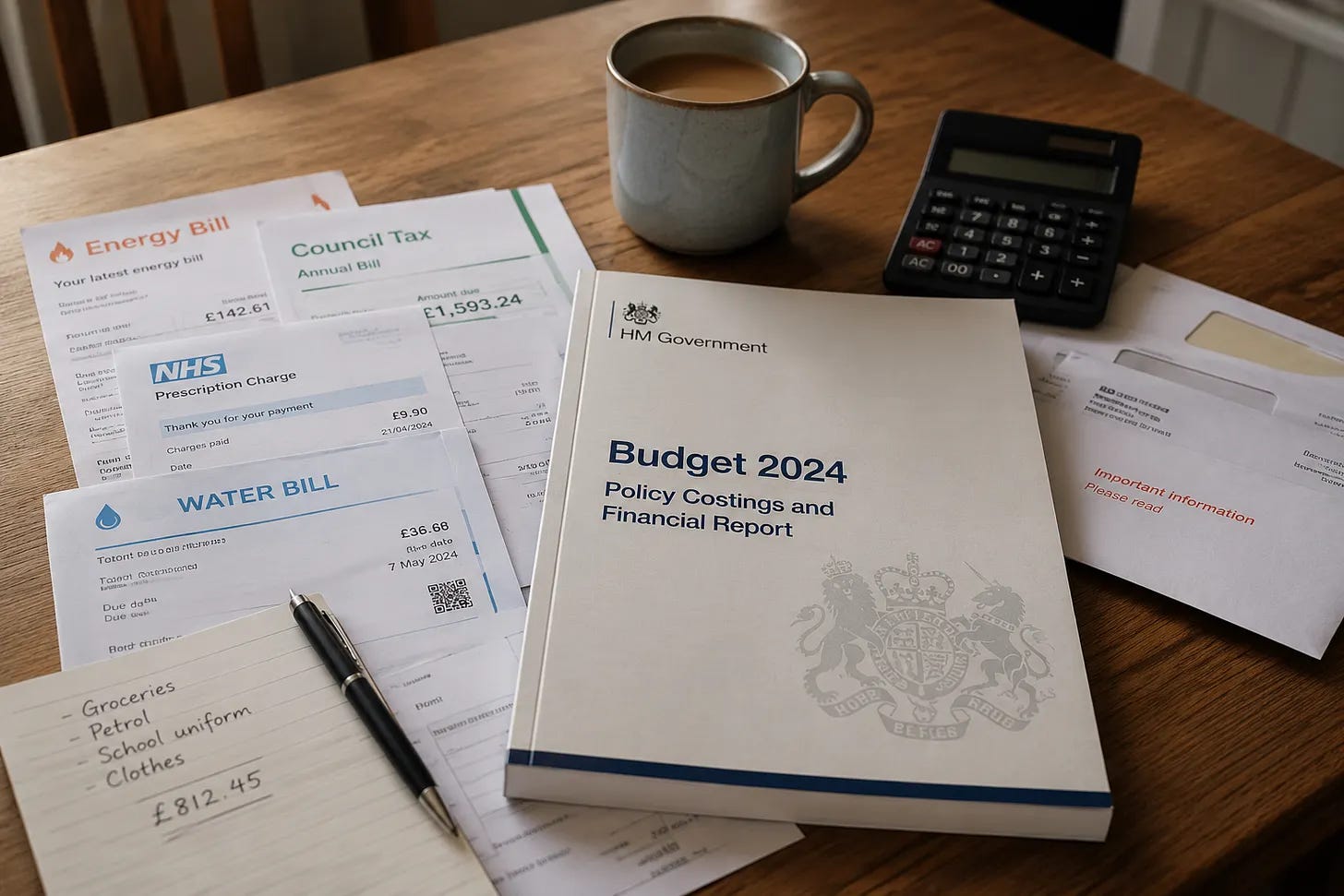
Millions are waiting for NHS treatment. Record numbers of households are living in temporary accommodation. Finding an NHS dentist remains difficult for many. Yet Britain still spends billions internationally. Helping people overseas can be right. But when resources are limited, taxpayers are entitled to ask: why was spending the money there more important than spending it here?
When I was working, if I ran short of money, I had to make choices.
I couldn’t keep spending on everything simply because everything seemed worthwhile. I had to decide what was essential, what could wait and what I could no longer afford.
If things became difficult enough, even charitable giving would have had to be reduced. Not because I’d stopped caring, but because I had responsibilities of my own.
Government finances are far more complicated than a household budget. Governments can borrow, tax and invest in ways individuals cannot.
But one principle doesn’t disappear:
Money committed to one priority cannot simultaneously be committed to another.
And that raises a question I suspect an increasing number of people are asking.
Look at what people experience
Most people don’t experience Britain through Treasury spreadsheets.
They experience it when they need something.
In England, the NHS elective waiting list stands at around 7.11 million pathways.
At the end of March 2026, 135,580 households were living in temporary accommodation — a record high.
The latest published NHS dental statistics showed that only around 40% of adults in England had seen an NHS dentist during the previous two years.
There are complicated reasons behind every one of those figures.
Money alone won’t solve them. You can’t train a doctor overnight. Building houses requires land, planning, workers and infrastructure. NHS dentistry has workforce and contractual problems as well as funding problems.
But try explaining all that to someone who has paid tax for decades and can’t find an NHS dentist.
Or someone whose family member has been waiting months for treatment.
Or someone worried about keeping a roof over their head.
Then they hear another announcement about millions or billions being committed internationally.
It’s hardly surprising if they ask:
What about us?
So how much are we actually spending?
Let’s get the number right, because this argument is frequently distorted.
Britain did not simply hand £14 billion to foreign governments in 2024.
According to the government’s final development statistics, UK Official Development Assistance — ODA — totalled £14.082 billion in 2024. Of that, £11.273 billion was bilateral ODA, while £2.809 billion went into the core budgets of multilateral organisations.
Another £2.827 billion — 20.1% of total ODA — was classified as support for refugees and asylum seekers in donor countries, principally reflecting costs incurred within the UK asylum and refugee system.
So anyone claiming Britain simply “gave £14 billion to foreign governments” isn’t accurately describing what happened.
But correcting that misconception shouldn’t end the discussion.
It was still £14.082 billion of public expenditure.
We are entitled to ask what we achieved with it.
No, foreign aid didn’t break Britain
This needs saying clearly.
Foreign aid did not cause NHS waiting lists.
It did not cause Britain’s housing shortage.
And cancelling the entire aid budget tomorrow wouldn’t suddenly produce millions of dental appointments, thousands of houses or enough doctors and nurses.
Foreign aid is also only a relatively small part of total government expenditure.
But none of that means we shouldn’t scrutinise it.
The question isn’t whether foreign aid caused Britain’s domestic problems.
It didn’t.
The question is:
When Britain has competing needs, how does government decide which deserves the money?
Government is already making that choice
We know this isn’t simply a theoretical argument because government is already reducing aid expenditure.
UK aid spending is expected to fall to 0.3% of Gross National Income in 2027/28.
The House of Commons Library estimates that this would mean spending of around £9.2 billion, compared with approximately £15.4 billion had spending remained at 0.5%. The government expects the reduction to provide around £6.5 billion towards increased defence expenditure in that year.
Government has therefore already accepted the principle.
Circumstances change. Priorities change. Money previously committed to one purpose can be redirected towards another.
If government can decide that defence now deserves greater priority than some international development spending, taxpayers are entitled to ask where healthcare, housing, social care and other domestic pressures sit in that calculation.
Show us what the money achieved
This is where government could make a much stronger case for international spending.
Don’t simply tell people that £100 million went into an international development programme.
Tell them what happened because of it.
If British money vaccinated a million children, show us. If it prevented famine, demonstrate it. If an investment generated a return, tell us what that return was.
If expenditure helped prevent instability that threatened British interests, explain how.
And if a programme failed, tell us that too.
This isn’t an unreasonable demand.
Britain’s own Independent Commission for Aid Impact concluded in March 2026 that management of the aid budget over the period it examined had not always been based on clear priorities or evidence of good value for money.
That doesn’t mean foreign aid is a waste of money.
It means taxpayers asking about value for money have a legitimate question.
When should another country pay first?
There is another question that deserves to be asked.
What happens when Britain provides assistance connected with a country that has substantial resources of its own?
It might have a large economy. It might receive substantial revenues from oil, gas or minerals. It might be capable of funding advanced technology, major infrastructure or a space programme.
None of that means everybody living there is wealthy.
Countries can possess enormous resources while millions of citizens remain poor.
But that creates a difficult question:
What responsibility does that country’s government have to help its own population before British taxpayers are asked to contribute?
There may be excellent reasons for Britain to become involved.
Perhaps we’re responding to an emergency. Perhaps we’re providing expertise. Perhaps it’s an investment rather than a grant. Perhaps there is an important British strategic interest.
And sometimes helping vulnerable people may be justified despite the failures or priorities of their government.
But those distinctions matter.
British taxpayers should be able to distinguish between helping a country that genuinely cannot meet a need and contributing where another government possesses substantial resources of its own.
That doesn’t mean abandoning ordinary people because of decisions made by their government.
It means asking who should reasonably be expected to pay first.
Sometimes spending abroad will be the better choice
The argument has to work both ways.
Suppose spending £100 million overseas prevents an infectious disease spreading internationally.
That could save lives abroad while protecting Britain and avoiding far greater expenditure later.
Perhaps supporting stability somewhere prevents conflict, displacement or a future security problem.
Perhaps development creates an important trading partner.
Perhaps spending overseas genuinely produces more benefit than spending the same amount here.
If that’s the evidence, then spending abroad may be the right decision.
And sometimes the justification is simply humanitarian.
If thousands of people are starving after an earthquake, famine or war, I don’t want Britain to become a country that simply looks the other way.
But compassion and accountability aren’t opposites.
We should be capable of both.
And apply exactly the same test at home
Keeping money inside Britain doesn’t automatically make it good spending.
Waste £100 million domestically and taxpayers are still £100 million poorer.
So the standard should be universal:
What was the objective? What did it cost? Did it work? Could we have achieved more by spending the money differently?
If we expect government to answer those questions about spending overseas, we should expect exactly the same answers about spending at home.
Give taxpayers the receipt
Government already publishes enormous amounts of information about international development.
But publication and accessibility aren’t the same thing.
An ordinary taxpayer shouldn’t need to understand government accounting or search through spreadsheets to discover what happened to billions of pounds.
Give us an understandable annual account.
Tell us how much Britain spent, where the largest amounts went, whether they were grants, investments or contributions to international organisations, what they were supposed to achieve and what actually happened.
Tell us which programmes succeeded and which failed.
And for significant expenditure, answer something we rarely hear:
Why was spending that money there considered better than spending it somewhere else?
That would be genuine transparency.
If you value independent analysis that follows the numbers rather than telling you what to think, subscribe to Beyond the Headlines. It’s free.
This is bigger than foreign aid
Ultimately, I think this is becoming a question about trust.
Someone who cannot find an NHS dentist doesn’t care which departmental budget pays for international development.
Someone living in temporary accommodation doesn’t experience government through percentages of GDP.
They experience government through what happens to them.
If they repeatedly hear that resources are limited when they need something, while simultaneously seeing government find money for other priorities, they will ask questions.
That doesn’t mean their conclusions will always be correct.
Some overseas expenditure may represent extraordinarily good value. Some claims circulating online about foreign spending are misleading or simply wrong.
But dismissing the underlying question is a mistake.
When people stop trusting official explanations, they don’t stop looking for explanations.
They find them somewhere else.
That makes transparency more important, not less.
Responsibility begins at home
We’ve all heard the phrase:
“Charity begins at home.”
I don’t think that quite captures it.
Britain has responsibilities beyond its borders.
We have allies, security interests and international commitments. Sometimes helping another human being who is suffering is simply the right thing to do.
But I’d put another principle alongside it:
Responsibility begins at home.
Government’s responsibility is to make choices on our behalf and then be capable of defending them.
That means recognising the pressures people experience here while explaining why some of our resources are better used elsewhere.
It also means admitting when priorities need to change.
Who comes first?
I don’t think the answer is automatically Britain every time.
And I don’t think international spending should automatically be protected from challenge because its purpose is worthy.
Government may be able to justify much of this expenditure.
Some of it saves lives. Some may protect British interests. Some may prevent much greater costs later.
Then make that case.
But when someone struggling to obtain healthcare, find affordable housing or access overstretched public services asks why Britain can afford billions internationally, the answer cannot simply be that government has decided the spending is necessary.
Explain the choice.
Show the outcome.
And accept that taxpayers are entitled to question whether the priority was right.
Trust shouldn’t be the starting point of accountability. It should be the result of it.
Sources
Use these as the principal source links in the Substack article rather than filling the piece with secondary reporting: