

Before you read
This article has two distinct parts.
Part One is based on Britain as it exists today. It looks at immigration statistics, illegal-working enforcement, Digital ID and facial recognition. These sections are based on published evidence.
Part Two is a fictional thought experiment. It is not announced government policy, a prediction of what will happen, or a claim about the intentions of the current government.
Instead, it asks what might happen if today’s measures failed, public confidence continued to deteriorate and a future government decided that controlling illegal immigration justified much more intrusive identity checks.
The technology discussed in the scenario has roots in the present.
The future described does not.
The argument in 60 seconds
Britain is strengthening identity and Right to Work checks in an attempt to make illegal working harder.
Digital ID could make those checks more reliable without requiring the population to be continuously identified by the state. Facial recognition is separately already being used for defined law-enforcement purposes.
But suppose those measures don’t solve the problem.
Imagine a future government proposing compulsory biometric registration, arguing that everyone legally entitled to live in Britain should be able to prove it.
Then imagine that identity infrastructure being connected to increasingly sophisticated facial recognition.
Now make the question harder.
Suppose it actually worked.
Illegal working falls. Immigration enforcement becomes more effective. Identity fraud becomes harder. Serious offenders become easier to identify.
Would you accept the loss of anonymity?
This article isn’t predicting that future.
It’s asking where we would draw the line if technology eventually made that choice possible.
A note about the numbers
Immigration statistics have become part of the political argument themselves.
Some people trust official figures. Others question whether government statistics capture the full picture, how particular categories are defined, or whether politicians selectively use figures that support their case.
That scepticism shouldn’t simply be dismissed. But neither should suspicion be treated as evidence that official statistics are false.
For this article, I use published Home Office and Office for National Statistics data as the starting point because they provide the most comprehensive publicly available national datasets.
That doesn’t mean accepting a government’s interpretation of them.
Where something is an estimate, I describe it as an estimate. Where figures represent detected or recorded activity, I don’t assume they capture activity that was never detected. Where figures are provisional and may subsequently be revised, that matters too.
The sources are provided so readers can examine the evidence themselves.
There is another reason for caution. The Home Office is due to publish its next quarterly immigration statistics on 27 August 2026. The figures below therefore represent the latest published information available when this article was written.
PART ONE — BRITAIN TODAY
Start by separating different kinds of immigration
Before looking forward, we need to separate several things that are often mixed together.
Legal immigration is not illegal immigration. An asylum seeker is not automatically an illegal immigrant. Someone entering Britain through an illegal route is not automatically someone who will ultimately be found to have no right to remain. Someone can also enter Britain legally and subsequently lose their legal right to remain.
Those distinctions matter.
Britain permits people to come here legally to work, study, join family and for other reasons. It also has obligations towards people entitled to protection.
At the same time, Britain has a legitimate interest in controlling its borders and enforcing decisions against people who have no legal right to remain.
Those positions aren’t contradictory.
The numbers are changing
One fact sometimes lost in the argument is that overall migration has already fallen substantially.
The Office for National Statistics provisionally estimates long-term net migration at 171,000 in the year ending December 2025, compared with 331,000 a year earlier and a peak of 944,000 in the year ending March 2023.
ONS describes these as provisional estimates and official statistics in development. They are produced using administrative information and statistical methods rather than being a literal count of every person entering and leaving Britain, and estimates can subsequently be revised.
Source: Office for National Statistics — Long-term international migration, provisional: year ending December 2025
But overall migration and illegal immigration are different problems. That’s why falling net migration doesn’t necessarily end the political argument.
Small boats remain highly visible. Illegal working remains a problem. Government continues removing people who have no legal right to remain and looking for more effective ways of enforcing the system.
The question therefore isn’t simply:
How many people came?
There is another question:
Do people believe the rules are actually being enforced?
The border we don’t normally see
Most television pictures of illegal immigration show boats.
But immigration control doesn’t finish when somebody reaches Britain. Someone living here without permission needs somewhere to live and some means of supporting themselves.
That makes employment important.
Between January and June 2026, Immigration Enforcement recorded 7,270 illegal-working visits and 4,756 arrests. Restaurants, takeaways and cafés accounted for the largest category of enforcement visits, while beauty businesses, retail, car washes, construction, warehousing and delivery services were also targeted.
In warehousing, distribution and delivery alone, the Home Office recorded 635 visits and 635 arrests during those six months.
The Home Office says the total represented a 31% increase in visits and a 20% increase in arrests compared with the same period in 2025.
Source: Home Office — Illegal working and enforcement activity to the end of June 2026
Those figures tell us about enforcement activity. They don’t tell us precisely how many people are working illegally across Britain.
But they demonstrate that the problem exists.
They also reveal something easily overlooked:
A border isn’t only a line around a country. There is another border inside the economy — the point at which somebody tries to get a job.
Consider the person bringing your dinner
Food delivery provides a useful example.
Millions of us order food through apps, and the system depends upon a large and flexible workforce.
Someone being foreign, speaking another language or delivering food tells us absolutely nothing about whether they have a legal right to work in Britain.
But the Home Office has publicly identified vulnerabilities involving illegal working and misuse of legitimate delivery accounts.
Deliveroo, Just Eat and Uber Eats have themselves worked with government on stronger identity and Right to Work checks. Government has also moved to strengthen Right to Work requirements across flexible-working arrangements.
Source: Home Office — Delivery firms to bolster rider security checks to stop illegal working
The issue isn’t whether these businesses deliberately facilitate illegal working. The available evidence shows them taking measures intended to prevent it.
The wider issue is whether flexible labour arrangements can create vulnerabilities that people without the legal right to work may exploit.
If somebody can earn money despite having no legal right to work, immigration enforcement becomes considerably more difficult.
That brings us to Digital ID.
Digital ID
Britain is developing a national Digital ID system.
The government’s case isn’t solely about immigration. It argues that Digital ID could make dealing with public services easier, reduce identity fraud and make proving who you are simpler.
But immigration enforcement is explicitly part of the case.
According to the government’s current explainer, the proposed Digital ID will include information such as name, date of birth, nationality or residency status and a photograph used as the basis for biometric security.
Government also says employers will be required to use it as evidence of someone’s Right to Work.
Source: UK Government — Digital ID scheme: explainer
The argument is straightforward.
If an employer can establish quickly and reliably whether somebody has permission to work, employing somebody illegally becomes harder.
For people entitled to live and work here, government argues that the same technology could make everyday identity checks and access to services easier.
That’s the bargain currently being offered.
There is an important limit
This is where we must distinguish what is happening today from what comes next in this article.
The government is not currently proposing that police should be able to stop anybody walking down the street and demand their Digital ID.
Its current published information says police will not receive a new general power to demand it, while the government’s consultation states that there is no general legal requirement in the UK to carry proof of identity at all times.
Nor is government proposing that facial-recognition cameras should continuously establish the identity of everybody going about their daily lives.
Britain does already use facial-recognition technology for defined law-enforcement purposes, and government has consulted on the legal framework governing its future use.
That raises genuine questions about privacy, proportionality and safeguards.
But it is not the universal identification system described later in this article.
That system is fictional.
PART TWO — A FICTIONAL FUTURE
From this point onwards, this article is a thought experiment.
The following scenarios are not announced government policy. They are not claims about what the current government secretly intends to do. And they are not predictions.
They take technologies and political problems that exist today and ask what choices a future government might face if today’s solutions proved insufficient.
Scenario One: It works
Imagine Britain in 2029.
Digital Right to Work checks have become routine and quick. Employers can establish someone’s status easily, loopholes involving flexible and gig-economy working have largely been closed, and employers deliberately using illegal labour face meaningful consequences.
Illegal working becomes substantially more difficult.
Meanwhile, asylum decisions become faster. Someone genuinely entitled to protection receives an answer more quickly, while someone who exhausts the legal process and is ultimately found to have no right to remain is removed more effectively.
Facial recognition continues to be used for defined law-enforcement purposes, subject to legal rules, oversight and safeguards.
Illegal immigration hasn’t disappeared. It probably never will. But government has greater control and public confidence begins to recover.
This might be the ideal outcome:
Better enforcement without fundamentally changing the relationship between the individual and the state.
Scenario Two: We continue struggling
Now imagine a different Britain in 2029.
People have found ways around the employment controls. Illegal working continues. Removal remains difficult in some cases. Small boats continue crossing the Channel.
Government announces another initiative, followed by another. Different political parties offer different solutions, but increasing numbers of people conclude that nobody has actually solved the problem.
Something potentially more damaging than the immigration statistics begins to deteriorate:
trust.
Social cohesion is complicated. Immigration isn’t responsible for every community tension, and it would be wrong to pretend otherwise.
Housing shortages, poverty, inequality, crime, misinformation, cultural differences, political rhetoric and declining confidence in institutions can all play a part. Nor does immigration automatically destroy cohesive communities.
But perceived loss of control can become another ingredient.
People begin asking why rules exist if government cannot enforce them. Others start blaming people who have done nothing wrong. Legal migrants can become associated with illegal immigration simply because of where they came from.
Communities become defensive. Politics becomes angrier. Simple solutions become increasingly attractive.
Eventually, government faces a choice.
Carry on — or do something much more radical.
SUBSTACK SUBSCRIBE BUTTON HERE
Beyond the Headlines separates what is happening from what might happen — without telling you what you’re supposed to think.
2030: A fictional Prime Minister makes an announcement
Remember: this is fiction.
A future Prime Minister stands behind a lectern in Downing Street.
The government says previous measures haven’t worked well enough. It has strengthened border enforcement, targeted criminal gangs, increased employer checks and introduced Digital ID.
But illegal working and illegal residence remain significant problems.
The fictional Prime Minister makes the case:
Britain cannot operate an effective immigration system if it cannot reliably establish who is legally entitled to live and work here.
Then comes the proposal.
Universal biometric registration
Every British citizen and every person legally resident in Britain must establish a verified identity.
It doesn’t necessarily mean carrying a plastic identity card. The identity could remain digital.
But registration is no longer optional.
Why would we accept it?
Because our hypothetical government would have a powerful argument.
If you’re legally entitled to live here, registration proves it. If you’re legally entitled to work, your employer can establish that immediately. If you’re entitled to certain benefits, government can establish your eligibility.
Identity fraud becomes harder. Borrowed identities become harder to use. People living illegally find it increasingly difficult to participate in the legitimate economy.
The government then asks:
If you have the legal right to be here, why would you object to proving it?
Many people might find that convincing.
Perhaps you would too.
Then comes facial recognition
Facial-recognition technology already exists today.
Our fictional government now proposes linking biometric identity more closely with immigration enforcement.
Instead of facial recognition simply helping authorities determine whether somebody matches a person they are looking for, a much broader identity infrastructure might eventually enable another question:
Can we establish who this person is?
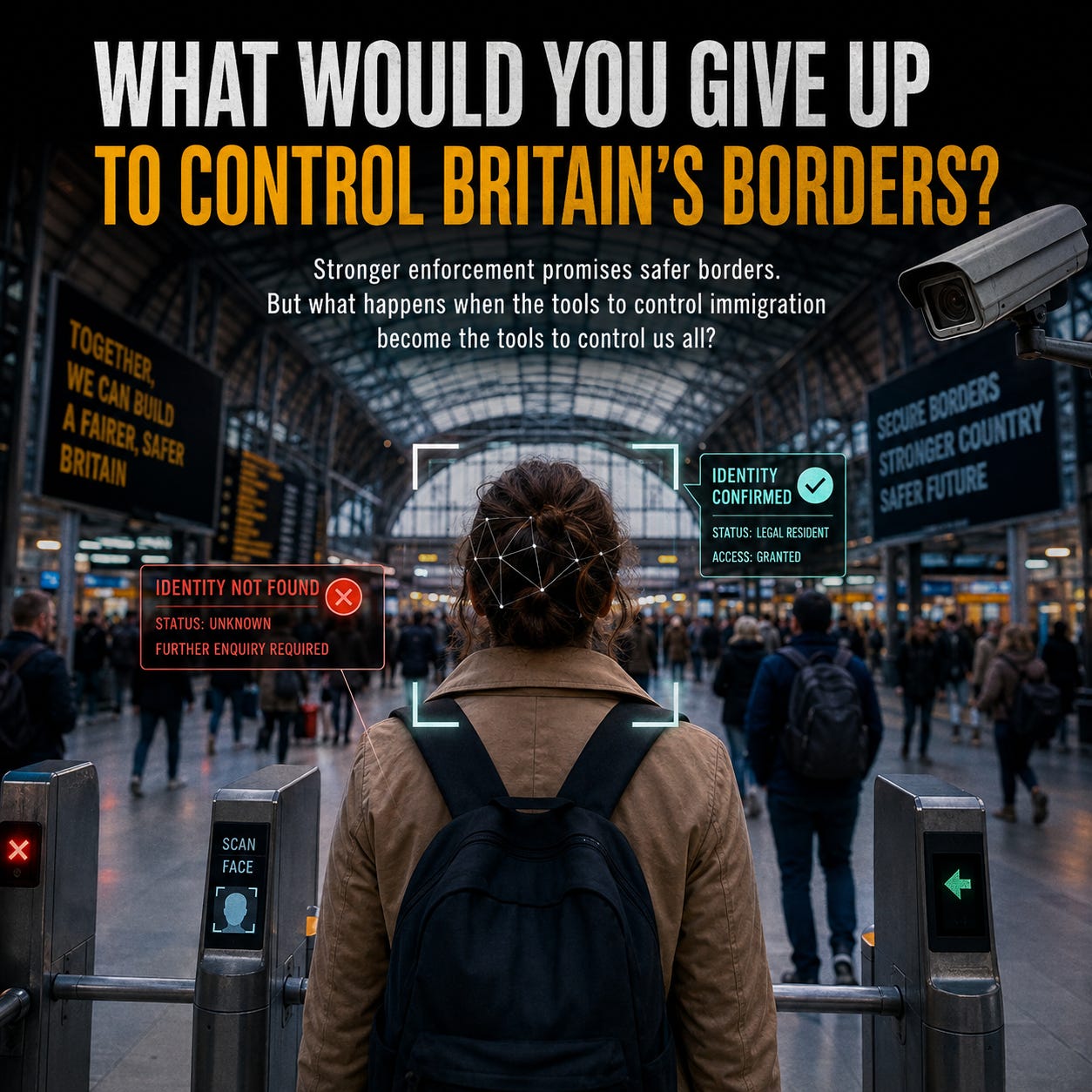
Imagine walking through a railway station.
A camera sees your face and your identity is established. Nothing happens. You continue walking.
Another person passes the camera and their identity cannot be established.
That doesn’t prove they’ve done anything wrong. There could be numerous innocent explanations.
But our fictional Parliament has passed legislation allowing that failure to establish identity to trigger further enquiries.
Now the question becomes personal.
Would you accept that?
Suppose it worked
This is where the argument becomes uncomfortable.
Don’t imagine an incompetent surveillance system.
Imagine an extremely effective one.
Illegal working falls dramatically. Borrowed and fraudulent identities become much harder to use. People ultimately found to have no right to remain become easier to locate.
Identity fraud falls. Serious criminals become easier to identify.
Government produces the results and says:
It worked.
What then?
The argument for saying yes
The case isn’t ridiculous.
Government already knows who holds a passport. Employers already check identity. Banks establish who their customers are. Airports use biometric technology. Phones recognise our faces. CCTV already records enormous amounts of public activity.
Supporters might therefore argue that universal digital identity is simply another stage in the development of a modern state.
They might argue that privacy shouldn’t become a shield behind which people can ignore immigration law, and that a country has a legitimate interest in establishing who is legally entitled to live and work within its borders.
If the system substantially improved immigration enforcement, perhaps losing some anonymity would be a reasonable price.
That is a legitimate argument.
The argument for saying no
But something fundamental would have changed.
Ordinary people going about lawful lives in Britain have historically not been required to continuously establish their identity to the state.
Under our fictional system, being unidentified could itself attract attention.
Instead of government needing a reason to identify you, you increasingly need to demonstrate to government that you belong.
And once the infrastructure exists, another question appears:
What else could we use it for?
Five years later
Move our fictional story forward to 2035.
The immigration system is working better. The technology is reliable. The database exists. The cameras exist. The public has become accustomed to them.
Another government comes to power.
It doesn’t need to build the infrastructure. It inherits it.
Someone asks:
If this system can identify people breaking immigration law, why shouldn’t we use it against serious organised crime?
Many people might agree.
Then terrorism. Violent offenders. People wanted by the courts.
Perhaps benefit fraud. Perhaps tax evasion. Perhaps public disorder.
Each extension could have its own reasonable justification.
Nobody needs to announce:
We’re creating a surveillance state.
Instead:
The technology already exists. It works. Why wouldn’t we use it to solve another serious problem?
This is sometimes called function creep: a system created for one legitimate purpose gradually acquires others.
It doesn’t require conspiracy.
It requires only useful technology and governments discovering additional uses for it.
Your face isn’t a password
Biometric identity creates another kind of risk.
Lose a password and you can change it. Lose a bank card and you can replace it.
You cannot replace your face.
The Information Commissioner’s Office says biometric-recognition systems used to uniquely identify somebody process special-category biometric data.
That leaves difficult questions.
Who can access the information and who can search it? How long is it retained? Can different databases be connected? What happens when the system makes a mistake, and how does somebody challenge it?
What happens after a security breach?
Can Parliament expand what the system is used for?
And what happens when the government operating it isn’t the government that originally created it?
What about the people the system gets wrong?
Not everybody unable to establish their identity is living here illegally.
Someone may be homeless or lack conventional documentation. Someone may have a disability or struggle with technology. An elderly person may not own a smartphone. Government records can simply be wrong.
The government’s current Digital ID proposal recognises some of these problems. It says physical alternatives will be available for people without smartphones, alongside face-to-face assistance and specialist casework for people who struggle to prove their identity.
Those safeguards would become even more important in our fictional compulsory system.
Because once identity becomes a gateway to ordinary life, getting someone’s identity wrong becomes considerably more serious.
So what would you give up?
Britain has a legitimate interest in controlling its borders.
It has obligations towards people genuinely entitled to protection.
Employers shouldn’t be able to gain an advantage by exploiting people who have no legal right to work, and people ultimately found to have no right to remain should expect immigration law to be enforced.
None of those positions requires a political label.
The difficult question is how far we’re prepared to go.
Digital Right to Work checks?
Stronger enforcement against employers?
Targeted facial recognition against defined watchlists?
Compulsory Digital ID?
Universal biometric registration?
Facial recognition capable of establishing the identity of ordinary people going about their lives?
At some point, most of us probably draw a line.
The interesting question is where.
Now make the decision harder
Suppose the strongest version really did work.
Illegal working falls dramatically. People without a legal right to work find it much harder to participate in the legitimate economy. People ultimately found to have no right to remain become easier to locate.
Identity fraud falls. Serious criminals become easier to identify. Public confidence begins to recover.
Would you accept compulsory biometric identification then?
Maybe your answer is yes.
Maybe it’s no.
Neither answer automatically makes someone authoritarian. Neither automatically makes someone soft on illegal immigration.
It means making a judgement about the balance between two things democracies need:
the ability of government to enforce the law
and
the ability of innocent people to live without unnecessary interference from government.
There may never be a perfect balance.
But perhaps there is one question we should ask before the technology makes the choice easier:
If we give government a power because we trust its purpose today, what safeguards would we want if one day we no longer trusted the people controlling it?
Evidence and scenario note
Part One describes current policy and evidence. Part Two is a fictional thought experiment.
References to future compulsory biometric registration, universal facial identification, automatic identity checking in public places and restrictions associated with that hypothetical system are not current UK government policy.
The fictional scenarios extrapolate from technologies, enforcement mechanisms and policy questions that exist today in order to examine the potential trade-off between more effective enforcement and individual liberty.
The Home Office is scheduled to publish its next quarterly immigration statistics on 27 August 2026. This article uses the latest published information available at the time of writing and will be reviewed against that release.
Sources
Office for National Statistics — Long-term international migration, provisional: year ending December 2025.
Home Office — Illegal working and enforcement activity to the end of June 2026.
UK Government — Digital ID scheme: explainer.
UK Government — Making public services work for you with your digital identity.
Home Office — Delivery firms to bolster rider security checks to stop illegal working.
Home Office — Legal framework for using facial recognition in law enforcement.
Information Commissioner’s Office — Biometric recognition guidance.