

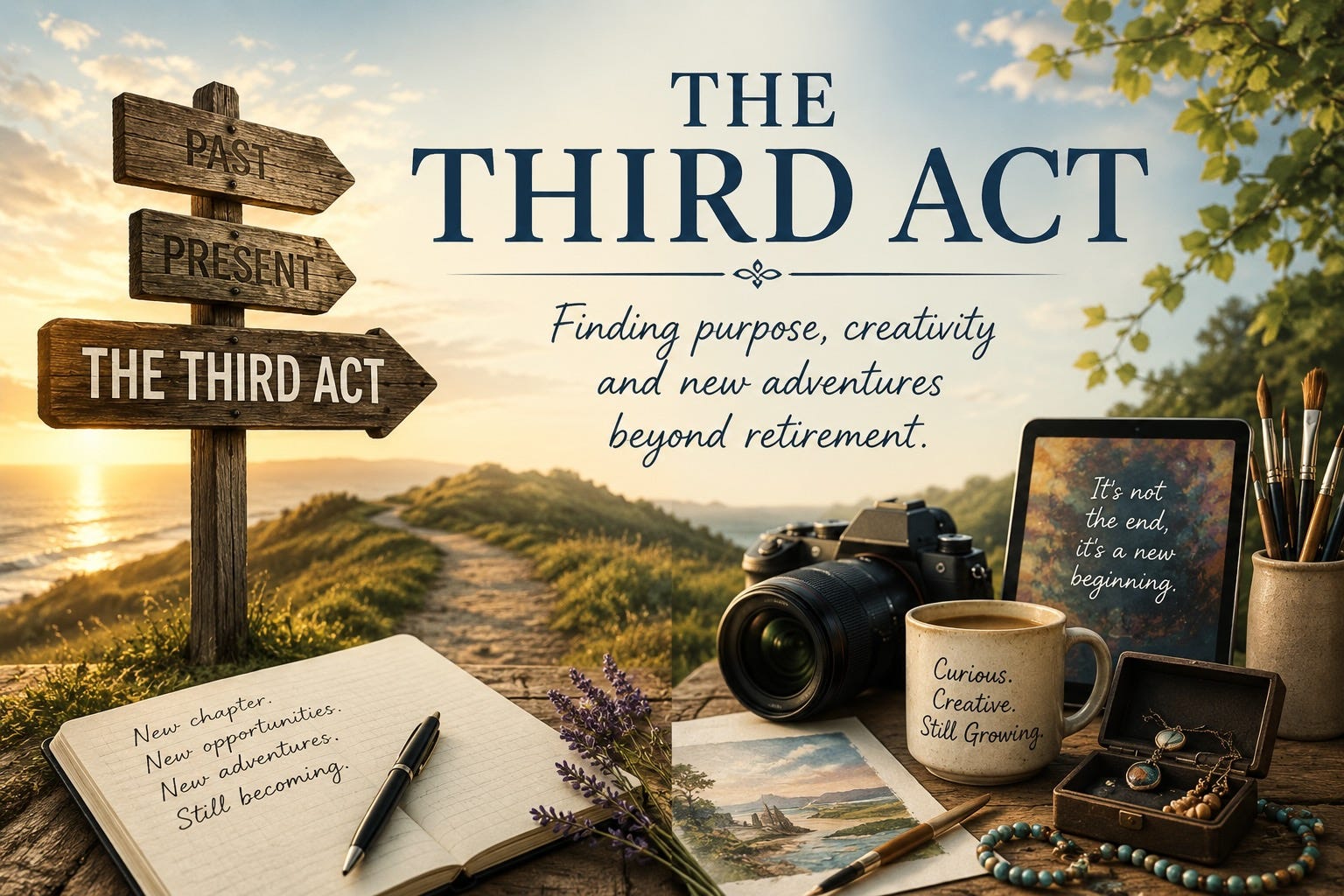
If you’re interested in how ordinary people can adapt to a rapidly changing world, consider subscribing to The Third Act. Every week I explore retirement, AI, purpose and what comes next.
When I was growing up, life seemed to come with a simple set of instructions.
Go to school.
Get qualifications.
Find a good job.
Work hard.
Pay into a pension.
Retire.
It wasn’t a perfect system, but it was a path that many people understood.
Today, I’m no longer convinced those rules are enough.
Artificial intelligence is changing the way we work. Entire industries are beginning to rethink how they operate. Universities are questioning what students should learn. Governments around the world are trying to regulate technology that evolves faster than legislation can keep up.
Whether we welcome those changes or fear them, one thing seems clear.
The world is changing.
The real question is whether we are changing with it.
Waiting isn’t a strategy
Whenever society goes through major change, it’s natural to hope things return to normal.
But what if this is the new normal?
What if AI continues to become more capable?
What if careers become less predictable?
What if people have to learn new skills several times during their lives instead of just once?
These aren’t questions for governments alone.
They’re questions for every one of us.
Taking back control
One thing I’ve noticed is how easily we hand over control without realising it.
We open social media for a few minutes.
Half an hour disappears.
We scroll from one short video to the next.
News becomes headlines.
Conversations become comments.
Our attention is constantly pulled in directions chosen by someone else’s algorithm.
At some point I realised I was spending more time consuming other people’s ideas than developing my own.
So I decided to change that.
My own Third Act
I’m 66 years old.
A few months ago, I had never written an article in my life.
I could have accepted the idea that writing wasn’t for people like me.
Instead, I decided to learn.
I discovered tools that helped me organise my thoughts.
I started writing.
Then I published.
Today I’ve written more than seventy articles.
Not because I suddenly became an author.
Because I stopped waiting for permission.
This isn’t really about AI
Some people will read this and think it’s an article about artificial intelligence.
It isn’t.
AI is simply one of the tools I’ve chosen to use.
The real story is about something much bigger.
It’s about refusing to believe that learning stops when we retire.
It’s about recognising that our experience still has value.
It’s about understanding that ordinary people can still create, teach, write and contribute.
Technology didn’t give me ideas.
It gave me a way to express them.
Perhaps the old rules need updating
For decades we were told to fit into a system.
Today we may need to become more adaptable than the system itself.
That doesn’t mean abandoning everything we’ve learned.
It means recognising that the world keeps moving.
The question isn’t whether change is coming.
It’s whether we’ll choose to move with it.
Why I created The Third Act
I’m not an economist.
I’m not a politician.
I’m simply someone who has watched the world change dramatically during my lifetime.
Like many people, I’m trying to understand where we’re going next.
I don’t pretend to have all the answers.
But I do believe we need to start asking better questions.
That’s why I created The Third Act.
Not to tell people what to think.
But to encourage people to think.
To question.
To adapt.
To keep learning.
Because I don’t believe retirement is the final chapter of our lives.
I believe it can be the beginning of the most interesting one.
If this article made you stop and think, I’d really appreciate it if you shared or restacked it.
The aim of The Third Act is simple: to encourage ordinary people to embrace change rather than fear it. If you know someone who might enjoy these conversations, please pass this article on.
And if you’d like to follow the journey, I’d love to welcome you as a subscriber.