The Quiet Architecture of Ordinary Life
There comes a point in life where you stop searching for excitement and start searching for clarity.
Not because ambition disappears.
But because noise becomes exhausting.
Modern life encourages constant stimulation. Notifications. Opinions. Content. Productivity. Outrage. Endless movement disguised as progress.
And yet many people quietly wake up each morning carrying the same invisible feeling:
“There has to be more to life than simply consuming the day.”
Lately, I’ve started noticing how much meaning hides inside ordinary routines.
A morning coffee.
A short walk.
A train journey.
A quiet café.
Rain against a window.
People stare silently into phones while entire worlds move around them unnoticed.
None of these moments sounds important individually.
But together they form the emotional architecture of modern life.
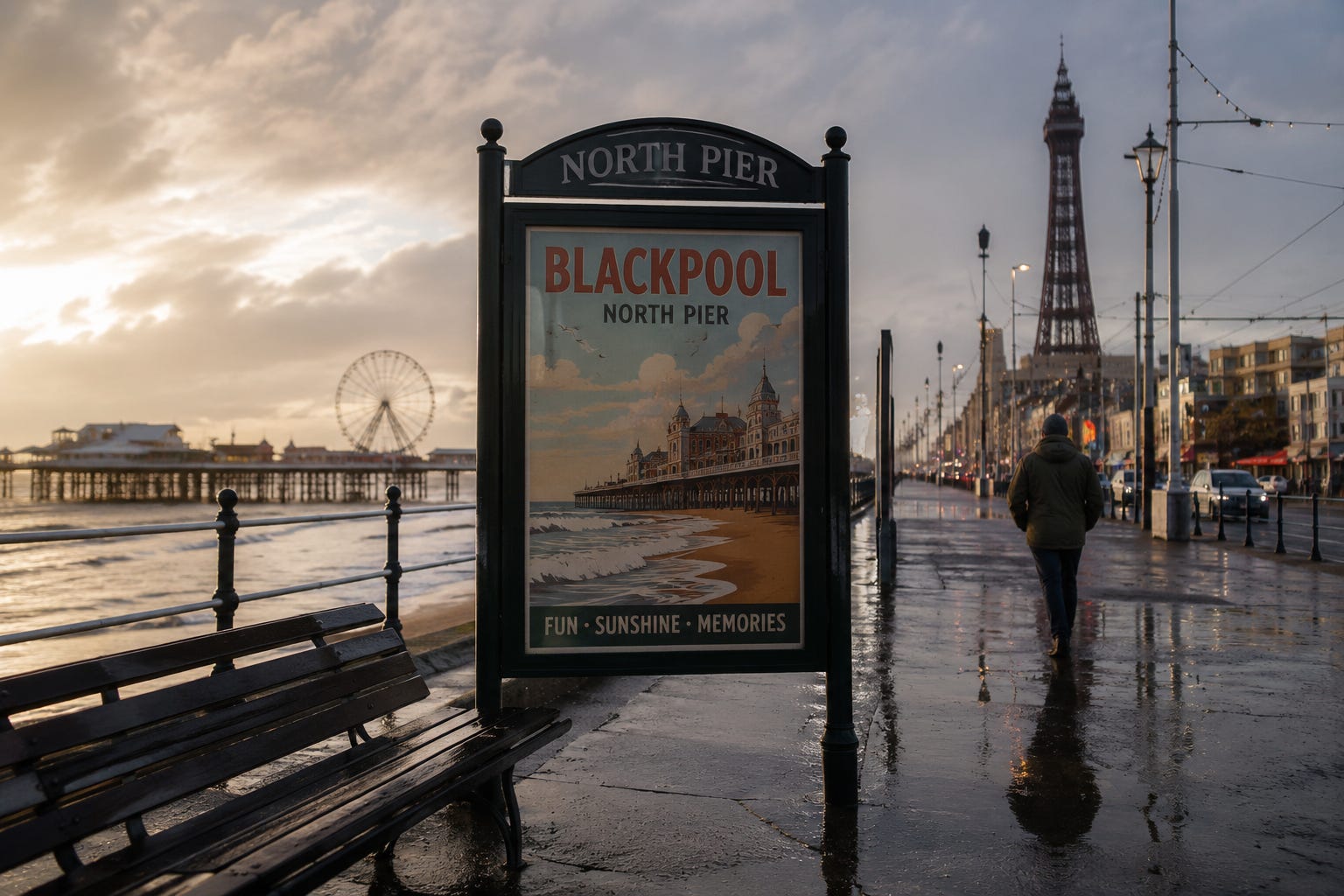
I recently spent a day in Blackpool, a seaside town in the UK, carrying nothing particularly dramatic with me. Just a laptop, a camera, a few thoughts, and the growing awareness that modern people rarely allow themselves to observe the world properly anymore.
British seaside towns have a strange emotional atmosphere.
They feel like places suspended between memory and survival.
Fragments of old optimism still cling to the arcades, piers and faded signage. Generations of holidays, family routines and working-class escape routes somehow remain embedded in the buildings themselves.
Walking through places like this makes you think about time.
About ageing.
About how quickly life quietly becomes memory.
As I filmed short clips along the promenade and watched people move through their own routines, I realised something uncomfortable:
Most of us spend our lives waiting for “important moments” while completely overlooking the life actually happening in front of us.
The modern world trains people to document everything instantly.
Take the photo.
Upload the thought.
Post the opinion.
Move on.
But perhaps reflection requires delay.
Perhaps we need time between experience and interpretation.
That thought stayed with me for most of the day.
Later, sitting quietly with my laptop open, I started organising notes, photographs, fragments of ideas and random observations. Nothing polished. Nothing designed for algorithms.
Just raw human observation.
And strangely, that process felt more meaningful than most of the endless digital noise surrounding modern life.
Technology often gets blamed for disconnecting people from reality.
But maybe the problem isn’t technology itself.
Maybe the problem is unconscious consumption.
Used differently, technology can become something else entirely:
A tool for reflection.
A memory archive.
A creative companion.
A way of recognising patterns hidden inside ordinary life.
The older I get, the more I realise meaningful living is probably less about dramatic reinvention and more about conscious observation.
Noticing habits.
Noticing atmosphere.
Noticing emotional reactions.
Noticing beauty hidden inside repetition.
Because ordinary life is not actually ordinary when you truly pay attention to it.
A short walk can become reflection.
A quiet café can become solitude instead of loneliness.
A photograph can become memory preservation.
Even routine itself can become a form of stability in a world increasingly designed to fragment attention.
Perhaps this is what many people are truly searching for now.
Not more information.
Not more stimulation.
But a way to reconnect with presence before life disappears into distraction entirely.
Maybe that’s why so many people feel emotionally exhausted despite having constant access to entertainment.
The modern world rarely allows silence long enough for people to hear themselves think.
And maybe that is why simple moments now feel quietly rebellious.
A walk without urgency.
A conversation without performance.
A day without optimisation.
A moment observed properly before it vanishes.
Because in the end, life is not built from extraordinary events alone.
It is built from thousands of small, unnoticed moments that slowly become who we are.