

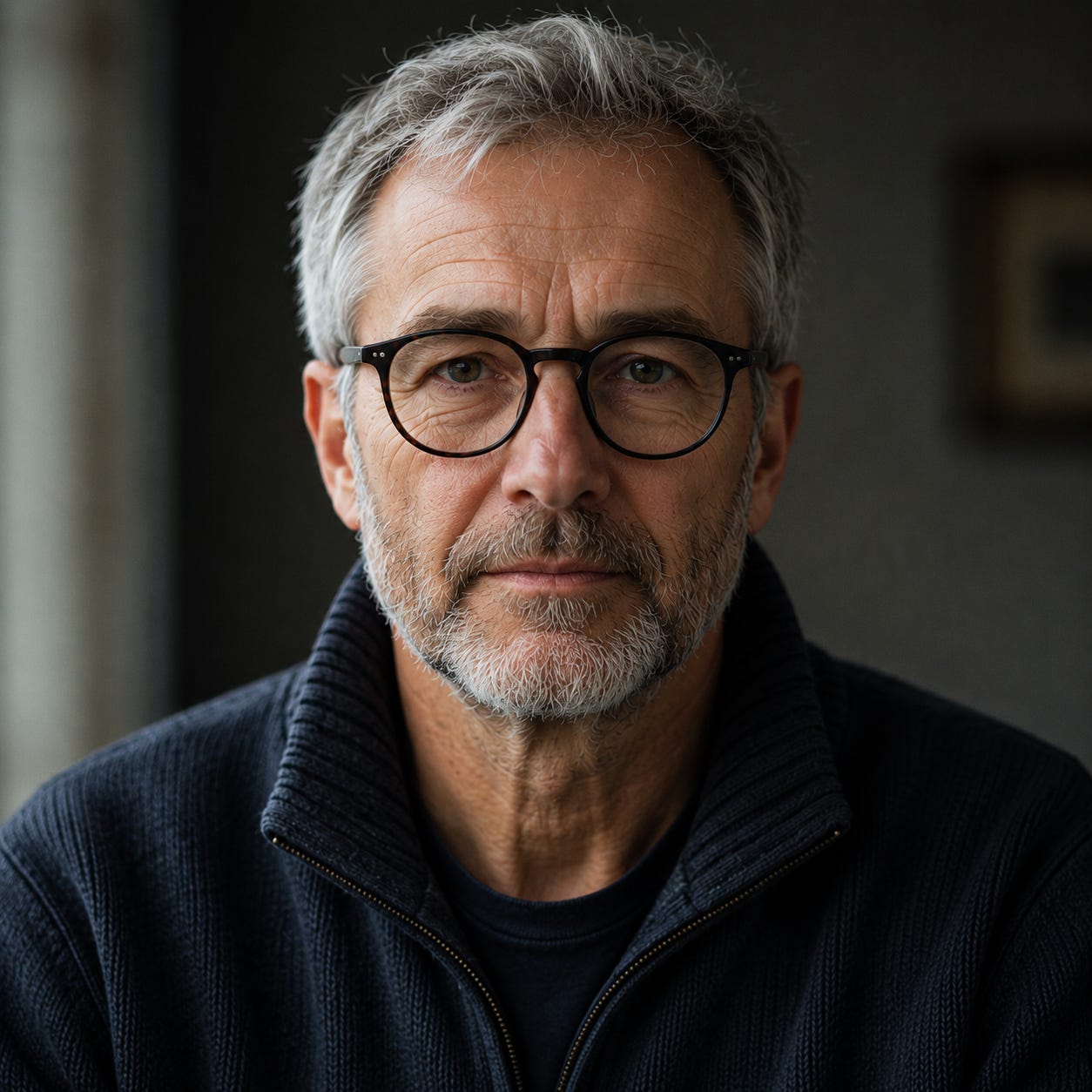
In a world where AI remembers everything, Michael meets a man whose extraordinary gift is remembering people—not their data, but their stories.
Letters, lives and lessons from a possible future
29 March 2045
Dear Thomas,
Last week, I met a man who possessed a skill that should have been completely worthless.
Yet people travelled across the country just to spend time with him.
His name was Arthur.
He was seventy-eight years old.
And he remembered everyone’s name.
Not because of technology.
Not because he had an implant.
Not because an AI whispered information into his ear.
He simply paid attention.
That may not sound remarkable to you.
In 2045, every device remembers everything.
Birthdays.
Preferences.
Conversations.
Medical history.
Favourite books.
Favourite foods.
Every detail is stored somewhere.
Memory became one of the first human abilities we outsourced.
At first, it seemed harmless.
Why remember phone numbers when your device remembers them?
Why remember appointments when your assistant schedules them?
Why remember facts when answers arrive instantly?
Little by little, we stopped exercising the muscle.
Arthur never made that trade.
I first encountered him in a small community workshop beside the river.
The building itself was unremarkable.
Old brick walls.
Wooden floors.
A smell of tea and sawdust.
Inside, people gathered to repair furniture, build toys, paint signs, and learn forgotten skills.
The sort of place modern society once dismissed as inefficient.
The sort of place that had quietly become important again.
When I entered, Arthur looked up.
“Michael.”
I stopped.
I had never met him.
At least I didn’t think I had.
He smiled.
“We spoke three years ago at a bus station.”
I stared at him.
Impossible.
“You were carrying a camera.”
Still impossible.
“You told me you liked photographing old buildings because they reminded you that people leave traces behind.”
Suddenly, I remembered.
A ten-minute conversation.
Three years earlier.
A stranger waiting for a delayed bus.
Arthur shook my hand.
“Good to see you again.”
What surprised me wasn’t that he remembered.
It was how remembering made me feel.
Seen.
Recognised.
Important.
Not because I was special.
Because I mattered enough for someone to remember.
Over the following weeks, I returned several times.
Each visit revealed the same pattern.
Arthur knew everyone.
Not in the superficial way machines know people.
Not lists of facts.
Not behavioural profiles.
Not predictive models.
Stories.
A young woman entered.
Arthur greeted her.
“How’s your father recovering after the operation?”
She smiled.
“Much better.”
An older man arrived.
Arthur asked:
“Did your grandson ever finish building that model railway?”
The man’s face lit up.
“He did.”
Another visitor appeared carrying a sketchbook.
Arthur remembered a drawing she had shown him nearly a year earlier.
The details themselves were small.
But together they created something powerful.
People felt valued.
One afternoon, I finally asked him.
“How do you do it?”
Arthur laughed.
“Do what?”
“Remember everybody.”
He considered the question.
Then shrugged.
“I listen.”
I waited for more.
There wasn’t any.
Seeing my confusion, he leaned forward.
“Most people wait for their turn to speak.”
He pointed around the room.
“I wait for the other person to finish.”
It sounded ridiculously simple.
Perhaps because it was.
Arthur believed modern society had created an illusion.
People thought they were communicating more than ever.
Billions of messages.
Constant updates.
Infinite connectivity.
Yet genuine attention had become scarce.
“People are hungry,” he told me.
“Not for information.”
He tapped the table.
“For attention.”
That sentence stayed with me.
The technology of 2045 could generate movies, books, music, conversations, education, therapy and companionship on demand.
Yet one thing remained stubbornly difficult.
Making another human being feel truly heard.
Machines could simulate attention.
Humans could give it.
The difference was subtle.
But people sensed it immediately.
A week later, I witnessed something extraordinary.
A teenager entered the workshop looking upset.
Nobody knew why.
Nobody asked.
Except Arthur.
He simply said:
“You don’t seem like yourself today.”
The boy sat down.
And talked.
For nearly an hour.
About fears.
Relationships.
The future.
Life.
Nothing dramatic.
Just the ordinary burdens people carry.
When he finished, Arthur offered no advice.
No solutions.
No analysis.
Just presence.
The boy left smiling.
Lighter somehow.
“That’s it?” I asked.
Arthur nodded.
“Most people don’t need fixing.”
He sipped his tea.
“They need witnessing.”
I thought about that for a long time.
For decades, society had become obsessed with solving problems.
Optimising outcomes.
Improving performance.
Maximising efficiency.
Everything became a project.
Even people.
Yet some parts of being human were never problems to solve.
They were experiences to share.
Before I left that evening, Arthur handed me a small notebook.
Blank pages.
Nothing more.
“What’s this for?”
“Names.”
I laughed.
“You want me to write them down?”
“No.”
He smiled.
“I want you to remember them.”
I still have that notebook.
Most pages remain empty.
Not because I’ve forgotten.
Because that wasn’t the point.
The notebook was a reminder.
A reminder that every stranger carries a story.
Every story carries a life.
And every life deserves more than being reduced to data.
In a world where machines remembered everything, Arthur taught me something unexpected.
Remembering facts is easy.
Remembering people is an act of care.
And care, Thomas, may become one of the most valuable human skills of all.
Michael
Reflection
Technology remembers what we click.
People remember what we reveal.
One creates profiles.
The other creates relationships.
The difference may determine what remains human in the years ahead.
Next Episode
The Library of Unwritten Lives
Michael discovers a strange project where people record the lives they almost lived—the businesses they never started, the journeys they never took, the loves they never pursued, and the dreams they abandoned.
Inside, he is forced to confront a question he has spent decades avoiding:
Who might he have become?