

Ageing is a strange thing.
When you are younger, you imagine ageing mostly in physical terms:
grey hair,
aches,
slower movement,
medical appointments,
the gradual wear and tear of the body.
What I did not expect was the psychological side of it.
The fear of becoming mentally old.
Not intellectually incapable.
Not unable to function.
But psychologically narrower.
More rigid.
Less curious.
Less willing to explore.
Less connected to possibility.
I think I became aware of this gradually.
Partly through retirement.
Partly through illness.
Partly through watching the world accelerate technologically while many people around me quietly withdrew from it.
After bowel cancer surgery, I became far more aware of time.
Not in a dramatic cinematic way.
More subtly.
You begin noticing how quickly routines solidify.
How easy it becomes to repeat the same days.
How fear slowly encourages smaller and safer versions of life.
Sometimes that shrinking happens so gradually that people barely notice it.
The world becomes reduced to:
familiar television,
familiar worries,
familiar conversations,
familiar limitations.
Curiosity fades first.
I think that frightened me more than physical ageing itself.
Because curiosity feels connected to psychological vitality.
When curiosity disappears, something else often disappears with it:
movement.
Not physical movement necessarily.
Mental movement.
The willingness to ask:
“What if?”
“Why?”
“Could I still learn this?”
“Could I still change?”
Modern life does not help.
Technology moves quickly.
Artificial intelligence appears everywhere almost overnight.
Entire industries shift.
Language changes.
Culture changes.
Media becomes louder, faster, more aggressive.
For many people, especially older adults, the easiest response is retreat.
To mentally step away from the modern world because it feels exhausting or alien.
I understand that instinct.
I have felt overwhelmed by it myself at times.
But somewhere inside me there has always been resistance to surrendering mentally.
Even during difficult periods:
poor sleep,
health anxiety,
digestive problems,
financial worries,
fear about the future.
Part of me still wanted to explore.
That desire led me into unexpected places:
AI,
digital art,
journaling,
creative systems,
philosophy,
storytelling,
technology,
reflection.
Not because I wanted to become a tech expert or productivity guru.
Honestly, I think I was searching for signs that psychological growth was still possible later in life.
That perhaps ageing did not need to mean mental shutdown.
I started noticing something important.
The people who remain psychologically alive are often not the people with the most status, money, or intelligence.
They are the people who remain open.
Open to:
learning,
wonder,
experimentation,
creativity,
uncertainty,
new perspectives.
That openness seems deeply connected to vitality.
Not youthfulness in the cosmetic sense.
But mental elasticity.
The ability to still become.
I think many people silently fear becoming irrelevant as they age.
Not always socially irrelevant.
Mentally irrelevant.
Disconnected from the future.
Unable to participate in the changing world around them.
Maybe that is one reason why curiosity matters so much.
Curiosity keeps a bridge open between who we were and who we might still become.
It creates movement where fear tries to create paralysis.
Lately I’ve realised that many of my conversations with AI are really part of this larger struggle.
Not simply about technology.
But about remaining engaged with the future instead of withdrawing from it.
Perhaps that is why these interactions feel strangely meaningful at times.
Not because machines replace human connection.
But because they can sometimes provoke reflection, exploration, creativity, and new ways of thinking.
Maybe that is part of staying mentally alive.
I do not have a neat conclusion yet.
Only an observation.
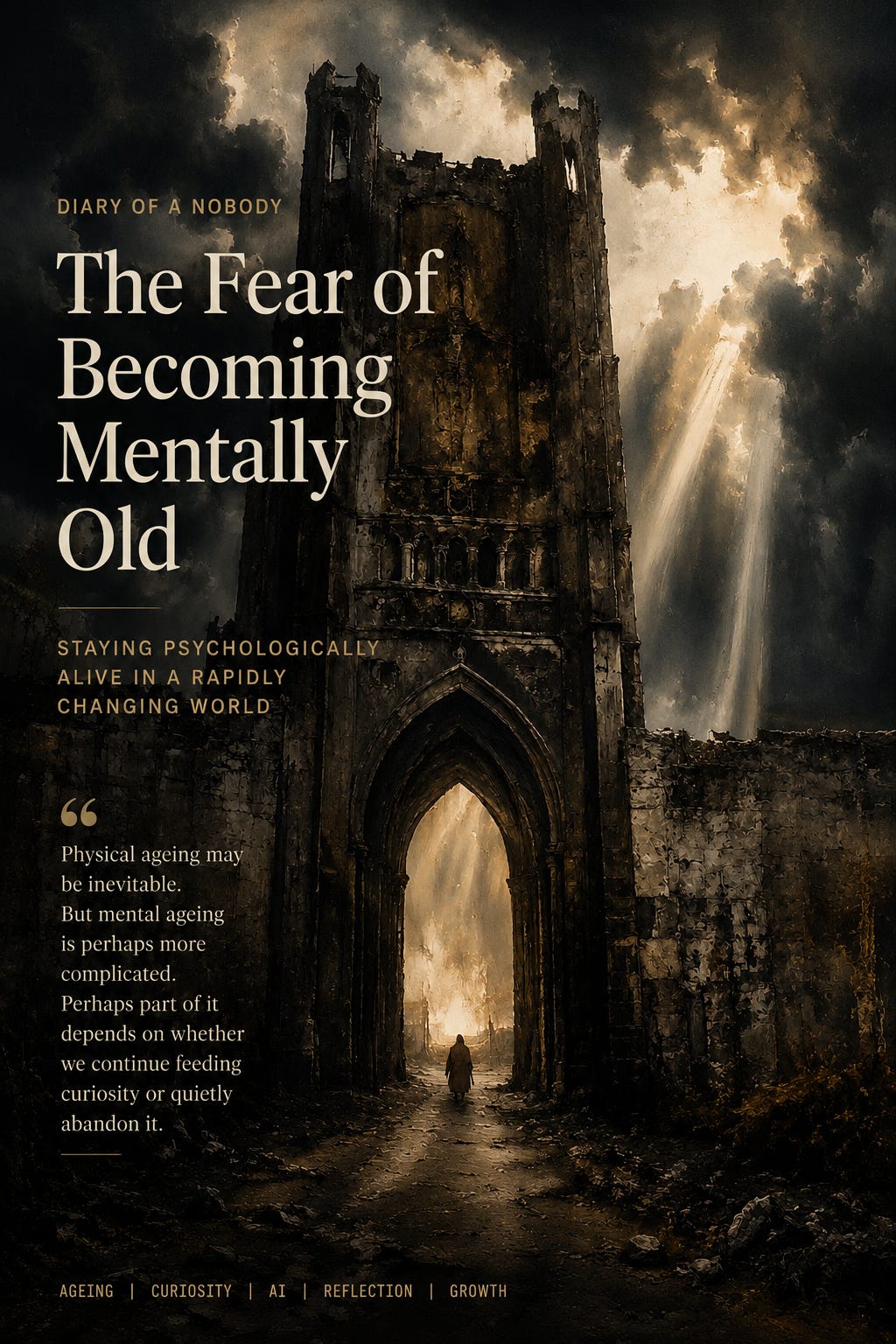
Physical ageing may be inevitable.
But mental ageing is perhaps more complicated.
Perhaps part of it depends on whether we continue feeding curiosity or quietly abandon it.
And maybe that decision happens in very small moments, every single day.