

The letter in 60 seconds
Don’t have time for the full letter? Here’s what happened.
I’m 67 and, like many people, occasionally need the NHS. Last month I needed it twice.
Getting help from my GP no longer meant simply phoning for an appointment. I was directed towards a form that would be assessed before I knew whether I’d get a conversation.
On another occasion, I went to A&E. I was triaged quickly and received tests, but then waited around eight hours to see a doctor.
The waiting room and corridors were full. I spoke to a man with cancer who told me he’d been waiting 12 hours on a trolley for a bed.
The NHS staff I encountered were working extremely hard in difficult circumstances. This isn’t an attack on them.
My experience wasn’t simply about waiting. It left me wondering what happens when accessing a public healthcare system becomes difficult enough that people who can afford alternatives begin paying privately.
I don’t claim to know whether what I experienced is the result of funding, demand, organisation, policy or some combination of them.
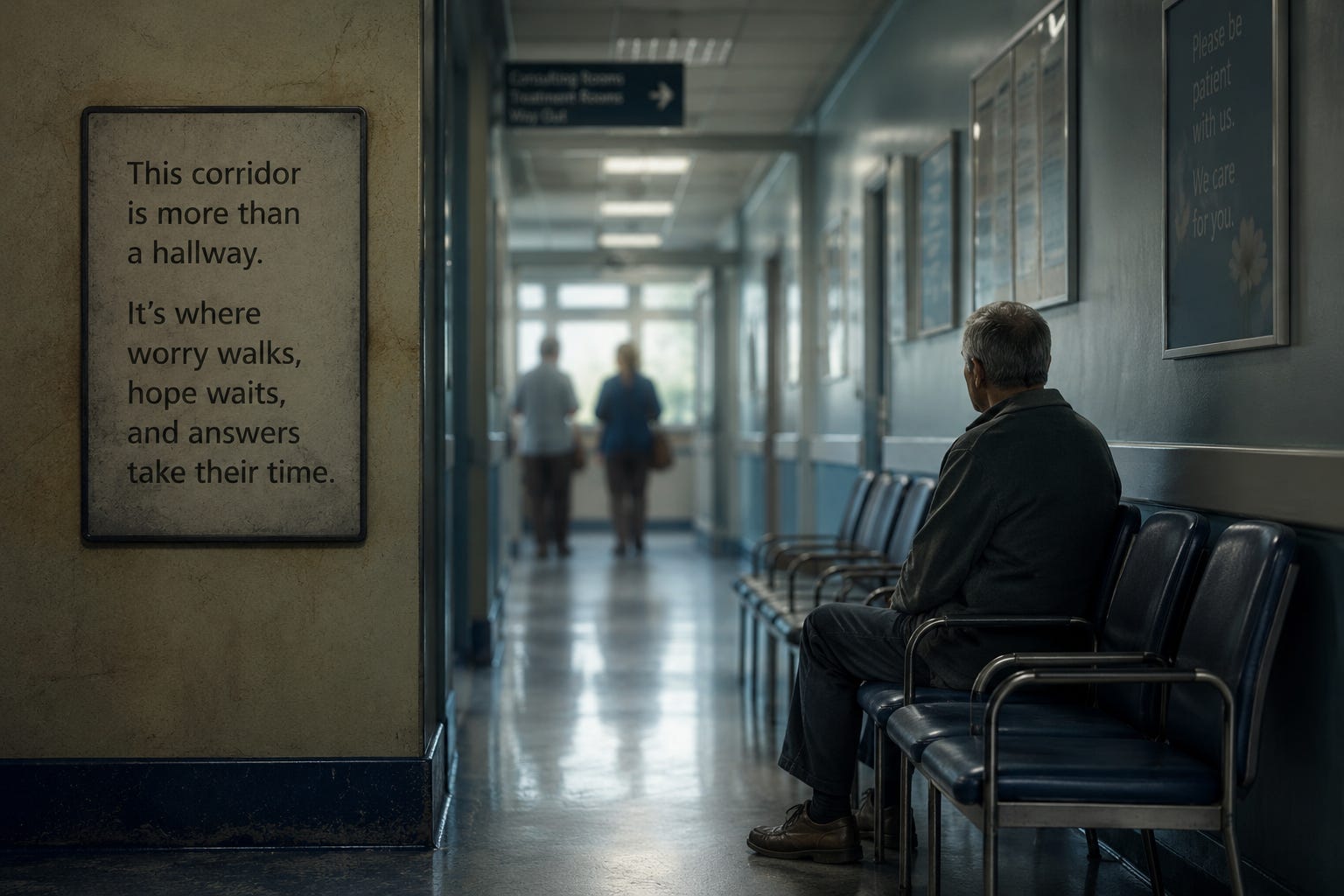
What I do know is what it feels like to be sitting in that corridor.
The full letter is below. ↓
I want to tell you about what it's like to need a doctor in Britain now. I'm 67. I've lived here my whole life. Last month, I needed one twice.
I occasionally need to call a doctor. I like to keep myself active, but I am a type 2 diabetic, which is common in the UK, and as you get older you do need the support of healthcare professionals, who do a fantastic job under difficult conditions.
Last month I needed to see my GP. For forty years, I called the surgery and asked for an appointment. Last month, I was told to fill out a form. Someone I have never met would read it and decide if my problem warranted a conversation. Or I could call 111, which lets you speak to someone, although there is usually a long wait, depending on the time of day.
In another instance I had to attend A&E. You are triaged quite quickly — I was. Then I had to wait about eight hours to see a doctor. The waiting room and corridors were completely full. Some people were on trolleys. To be fair, ECGs and blood tests came quickly. The delay was waiting for a doctor to read them.
The staff work damned hard in very difficult circumstances. I have seen them abused. I want to be clear: this is not their fault.
I was admitted around 8pm. By midnight, the hospital had gone quiet. I started talking to a man on a trolley next to me. He had drips and tubes everywhere — up his nose, in his arms. He told me he had cancer, and had been waiting twelve hours in a corridor for a bed.
I waited eight hours. NHS England's own data shows that last year, 40% of A&E patients waited more than four hours. The target is 95%. My wait was not unusual. It was the new normal.
I don't know whether this is mismanagement, arithmetic, or something more deliberate. What I know is the corridor. And what I know is that when a public system becomes this hard to use, and a private alternative exists, people with means will start to choose the alternative. I am one of those people. And I am wondering whether that was always the plan, or whether nobody in charge cares enough to stop it.
If you found this letter worth reading, The Third Act publishes weekly letters from Britain — on money, work, and what it means to live here now. No noise, just something worth sitting with.
Subscribe — it's free