

The date is not important. What happened before it—and what happened afterwards—is.
A different kind of Beyond the Headlines
I normally explore questions about power, institutions and accountability through argument and evidence.
This time I’m trying something different.
Fiction.
Nothing that follows is presented as fact, prediction or allegation. It is a thought experiment about democracy, fear and what might happen when ordinary people stop whispering.
Author’s note: The Coffee Shop Rebellion is a work of political fiction. Its government, politicians, organisations, legislation, technologies and events are fictional. It is not an allegation about any current or former British government, political party or individual.
The Accident
Nobody really intended to elect the government.
That was the strange thing.
There had been no revolution or great ideological awakening. Most people couldn’t name more than a handful of its senior politicians.
They were simply exhausted by the government already there.
Scandals had accumulated. Promises had been broken. Public services weren’t working as people expected. Ministers appeared on television explaining that things were improving while millions looked at their own lives and wondered what country they were describing.
Eventually the electorate decided it wanted the old government gone.
What replaced it almost didn’t matter.
The result shocked everyone.
Including the winners.
The new Prime Minister stood outside Downing Street promising a different kind of politics.
Government would listen again. Institutions would be rebuilt. Public confidence would be restored.
For a while, people believed it.
More importantly, for a while, much of it was true.
Then something changed.
Historians would later spend years trying to identify the moment.
They never found one.
Perhaps that was the point.
Good Intentions
The new government had inherited genuine problems.
Artificial intelligence could manufacture convincing photographs, voices and political messages.
Foreign governments were attempting to manipulate public opinion.
Threats against politicians were increasing.
Irregular migration remained unresolved.
Public confidence in institutions was falling.
Doing nothing wasn’t an option.
So the government acted.
Initially, many of its measures were reasonable.
Election safeguards were strengthened. Technology companies were required to cooperate more closely with authorities investigating serious threats. Public bodies received guidance intended to reduce discrimination.
Specialist organisations were invited to advise departments.
Most people barely noticed.
Inside the governing movement, however, a highly organised faction was acquiring influence.
It wasn’t particularly large.
It didn’t need to be.
Its members understood something the moderates didn’t.
Power doesn’t always belong to the largest group. Sometimes it belongs to the group most determined to use it.
Appointments changed.
Advisers changed.
Candidate-selection procedures changed.
The same organisations appeared repeatedly around government tables.
People who challenged the emerging consensus weren’t arrested.
They simply stopped being invited.
That distinction reassured everybody.
For a while.
Helen
Nobody officially lost their job for disagreeing with the government.
That would have been outrageous.
Instead, things happened.
Helen was fifty-three and had worked in administration for the same organisation for eleven years.
She wasn’t an activist.
She didn’t attend political meetings.
She had never stood for anything more controversial than secretary of the local gardening club.
One evening she went to dinner with friends.
The conversation turned to government policy.
Helen disagreed with something.
Nobody shouted.
Nobody was threatened.
Everyone went home.
Three weeks later she was called into a meeting.
Someone had reported what she’d said.
Her employer insisted she wasn’t being punished for holding an opinion.
There were simply concerns.
Judgement.
Reputation.
Workplace confidence.
Professional standards.
Eventually Helen left.
Whether she’d technically resigned or effectively been dismissed became something lawyers could have argued about.
Helen couldn’t afford lawyers.
So she stopped talking about politics.
Until one Thursday morning.
Frank’s Coffee House
Frank’s stood between a pharmacy and an empty shop that had once been a bank.
Twelve tables.
A scratched wooden counter.
Tea served in mismatched mugs.
Coffee considerably better than anyone expected.
Frank had owned it for twenty-three years.
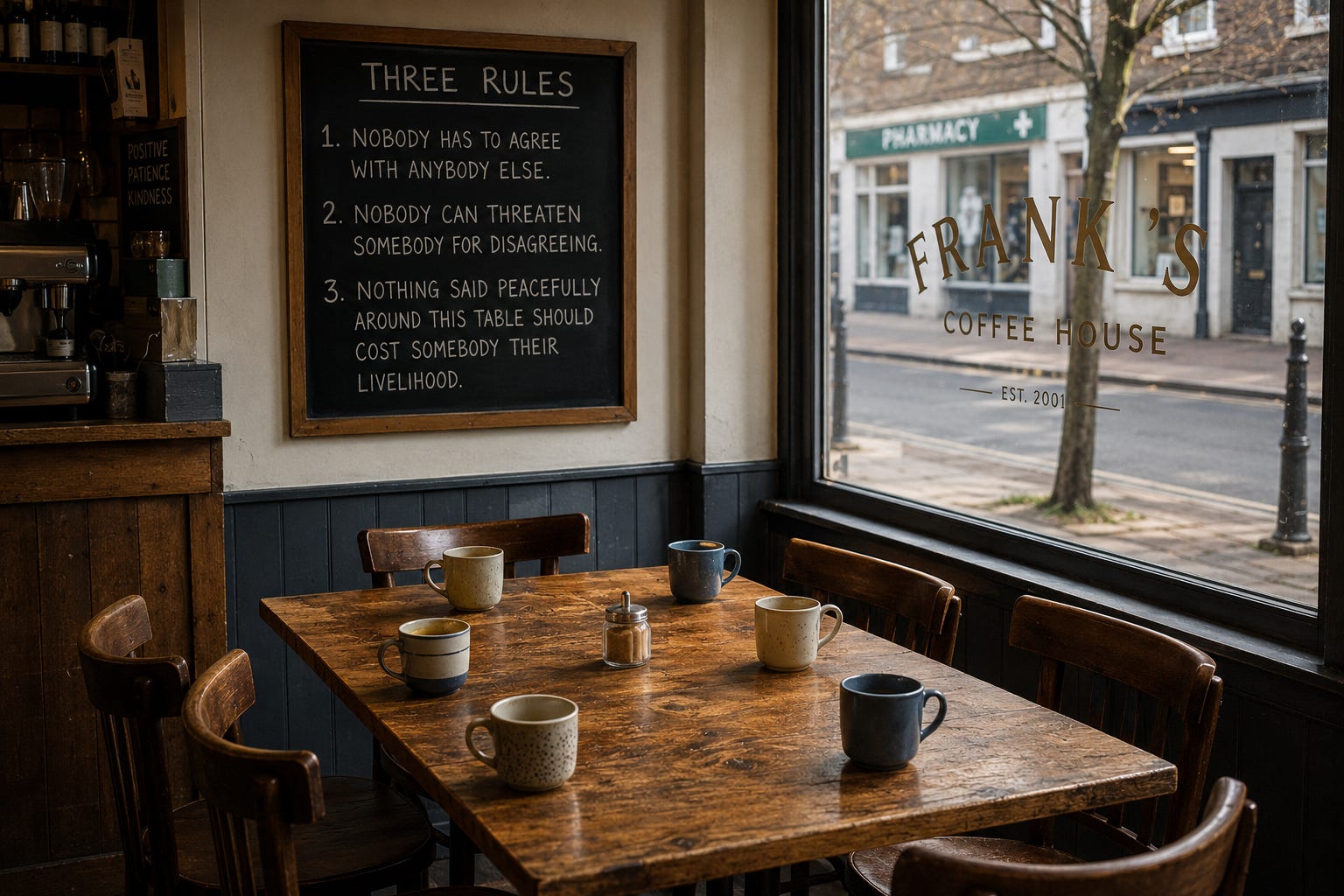
Every Thursday morning, six people occupied the table beside the window.
Margaret was a retired nurse who had spent forty years working in hospitals and possessed the unnerving ability to make everyone feel twelve years old when they behaved badly.
Samir owned the convenience store around the corner. He had spent most of his adult life being asked where he was “really from” and had developed an instinctive suspicion of anyone claiming to speak for an entire community.
Peter was an electrician. He distrusted government, academics and anybody who used the phrase stakeholder engagement.
Helen mostly listened.
Daniel lectured at a university and had never encountered a statement he couldn’t turn into a question.
Frank supplied the coffee.
They didn’t agree about much.
That was why Frank enjoyed Thursdays.
One morning Helen told them what had happened.
When she’d finished, nobody spoke.
Peter glanced towards the counter before giving his opinion.
Samir lowered his voice.
Margaret leaned closer.
Daniel watched them.
Then he asked:
“Why are we whispering?”
Nobody answered.
The following Thursday they met again.
Then again.
Eventually they established a rule.
Nobody had to agree with anybody else.
Another followed.
Nobody could threaten somebody for disagreeing.
And finally:
Nothing said peacefully around this table should cost somebody their livelihood.
A builder overheard them and asked if he could join.
Then a student.
Then a police officer who never gave his surname.
Frank pushed two tables together.
Someone jokingly called it Parliament.
“Absolutely not,” Frank said. “Parliament’s got enough problems.”
Margaret looked at the tables.
“The Coffee Table.”
The name stuck.
Protecting Democracy
Meanwhile, the government faced a problem it couldn’t simply ignore.
Election security.
Intelligence agencies had identified sophisticated attempts at foreign interference.
Deepfake recordings of candidates appeared online.
Fabricated documents circulated days before elections.
Anonymous accounts pushed contradictory stories designed less to persuade voters than to make them distrust everything.
The government introduced the Emergency Democracy Act.
It allowed an election in an affected area to be postponed where there was compelling evidence that the integrity of the vote had been seriously compromised.
The safeguards looked impressive.
Independent assessment.
Parliamentary oversight.
Time limits.
Most people thought it sensible.
The first postponement lasted three months.
There were unusual circumstances.
People accepted it.
Then another election was delayed.
Then another.
Six months this time.
The circumstances always seemed exceptional.
That was what made them difficult to challenge.
Inside the Room
Minister Rachel Mercer had been awake for nineteen hours when the intelligence briefing arrived.
She read it twice.
Foreign servers.
Thousands of fabricated accounts.
Artificially generated recordings of candidates.
Evidence that at least one hostile government was involved.
Across the table, a civil servant waited.
“If we allow the election to proceed,” Mercer said, “and we know somebody is trying to compromise it, what happens afterwards?”
The official didn’t answer.
“Whoever loses says the election was stolen. Whoever wins is accused of being illegitimate. We could spend years fighting about whether the result was real.”
“The alternative is postponement.”
“I know.”
“And people will say you’re cancelling elections.”
Mercer looked exhausted.
“What would you do?”
The civil servant hesitated.
“I don’t know.”
Neither did she.
That mattered.
Mercer hadn’t entered politics wanting to stop elections.
She genuinely believed she was protecting them.
When the Prime Minister approved another postponement, she defended it on television.
“Democracy isn’t simply holding a vote,” she said. “It’s ensuring people can trust the result.”
It was a good argument.
Daniel admitted as much at the Coffee Table.
“She’s right,” Peter said.
“Possibly,” Daniel replied.
“That’s not much of an answer.”
Daniel looked at him.
“The dangerous powers aren’t always created by bad people, Peter.”
“Then what’s the problem?”
“Good people eventually leave office.”
The Ring of Steel
As public support weakened, the government changed direction.
Organisations that had once enjoyed privileged access suddenly found themselves excluded. Advisory panels disappeared. Ministers announced that public institutions should no longer promote political ideology.
Peter approved.
Samir was less impressed.
“They loved these organisations when they agreed with them,” he said. “Now suddenly political influence is dangerous?”
“Maybe they’ve realised they were wrong,” Peter replied.
“Good.”
Samir shook his head.
“No. They’ve realised they want different people doing the influencing.”
Then came immigration.
Successive governments had promised to control irregular maritime arrivals.
An island was established as an offshore processing centre. People intercepted attempting unauthorised entry by sea would be taken there while identity, security and immigration decisions were made.
Then came the technology.
Radar.
Surveillance aircraft.
Autonomous maritime systems.
Artificial intelligence.
Drones.
Together they monitored Britain’s coastal approaches.
Government advertising gave the system a name.
THE RING OF STEEL
It was popular.
Peter supported it.
So did Samir.
Margaret surprised Daniel by supporting it too.
“A country needs to know who’s entering,” she said. “That’s hardly extremism.”
Daniel agreed.
His objection was different.
“Who controls the Ring of Steel?”
Peter laughed.
“The authorities.”
“Today.”
Peter sighed.
“Oh, here we go.”
Daniel put down his spoon.
“We keep asking whether we approve of what they’re using these systems for.”
He looked around the table.
“Maybe we should ask what else they could be used for.”
Rachel Mercer received the inland deployment order six months later.
The Ring of Steel had been designed to watch the coastline.
The new authorisation allowed parts of the system to monitor demonstrations where security agencies believed serious disorder was possible.
Mercer read the document.
Then she read it again.
“They aren’t the same thing,” she said.
Her security adviser shook his head.
“No. But the intelligence assessment says the technology could prevent violence.”
“Border surveillance and political demonstrations.”
“The system doesn’t know the difference.”
Mercer looked up.
“I do.”
The adviser slid the security assessment towards her.
It was detailed.
Professional.
Persuasive.
That was becoming the problem.
“What happens if we don’t use it and somebody dies?” he asked.
Mercer stared at the signature line.
Then she signed.
Weeks later the deployment widened again.
Critical infrastructure.
Government buildings.
Transport hubs.
Large demonstrations.
Political gatherings classified as potential security risks.
Mercer watched one of the drone feeds during a briefing.
Hundreds of citizens appeared as small moving shapes on a screen.
She remembered the coastline.
She remembered saying the system would keep people safe.
She could no longer remember precisely when protecting democracy had begun to require watching so many of the people participating in it.
The Tables Multiply
Someone photographed the three rules at Frank’s and posted them online.
Another café copied them.
Then another.
Coffee Tables appeared across Britain.
There was no organisation.
No membership.
No headquarters.
No leader.
People simply met.
Some wanted lower immigration. Others wanted higher immigration. Some wanted lower taxes. Others wanted stronger public services.
They argued.
Sometimes furiously.
Then ordered another coffee.
There was no ideology to ban.
The government initially ignored them.
Then mocked them.
Then people entering meetings began being photographed.
Employers received anonymous emails.
Businesses hosting Coffee Tables experienced unusual scrutiny.
Frank received four inspections in eleven days.
He passed every one.
Then someone smashed his windows.
Nobody knew who.
Police treated it as criminal damage.
Ministers condemned the attack.
Frank replaced the glass.
The following Thursday eighty-three people arrived.
There weren’t enough chairs.
Peter spent twenty minutes repairing a broken table instead of joining the discussion.
When Frank offered to pay him, he refused.
“You’ll only waste it on coffee.”
It was the first time Frank realised the table had become something more than furniture.
Fear worked when people experienced it alone.
It became less effective when frightened people discovered one another.
Beyond Britain
A photograph showed Frank standing beside his repaired window.
Someone had taped three sentences to the glass.
You don’t have to agree.
You don’t have to be silent.
Nobody should be frightened for speaking peacefully.
Three days later a café in Dublin displayed the same words.
Then Cork.
Galway.
Amsterdam.
Warsaw.
Madrid.
Prague.
Nobody coordinated it.
The languages changed.
The principle didn’t.
Journalists gave it a name.
The Coffee Shop Rebellion.
Frank hated it.
“We’re not rebelling,” he told a reporter.
“What are you doing?”
Frank considered the question.
“Talking.”
“Your government seems worried about people talking.”
Frank looked through the window.
“Perhaps that’s the problem.”
The Tipping Point
Something was changing inside the institutions themselves.
Police officers attended Coffee Tables.
Civil servants came.
Doctors.
Teachers.
Lawyers.
Some soldiers when off duty.
They didn’t swear allegiance to the movement.
There was nothing to swear allegiance to.
Instead, officials began asking questions.
Police officers asked whether particular orders were lawful.
Civil servants requested controversial instructions in writing.
Government lawyers challenged increasingly expansive interpretations of emergency powers.
Judges scrutinised government decisions.
There was no coup.
Nobody wanted one.
The Coffee Tables repeatedly said the same thing:
We don’t want to overthrow the government. We want the right to vote it out.
The distinction mattered.
If you value independent writing that asks difficult questions without telling you what to think, subscribe to Beyond the Headlines.
The New Media
Independent publications that had once struggled for audiences suddenly found millions looking for alternatives.
Podcasts grew.
Small broadcasters expanded.
Journalists investigated leaked documents.
Some reporting was excellent.
Some partisan.
Some nonsense.
Freedom didn’t guarantee quality.
It guaranteed competition.
The government attacked what became known as the New Media.
Irresponsible.
Extremist.
Dangerous.
The labels gradually stopped working.
Established broadcasters continued operating. Some challenged government. Others remained supportive.
Nobody needed to silence them.
People simply looked elsewhere.
Every government announcement now generated questions.
Where is the evidence?
Who authorised this?
Who oversees it?
When does the power expire?
And increasingly:
When do we get to vote you out?
Two Responses
Other governments watched.
Some responded by reviewing emergency powers, strengthening oversight and answering uncomfortable questions.
In those countries, something surprising happened.
Coffee Tables gradually emptied.
People who believed they could remove their governments democratically had less reason to organise against them.
Others responded with restrictions.
Journalists were investigated.
Surveillance expanded.
Intelligence began passing between governments.
In those countries the tables multiplied.
For the first time, the Coffee Tables faced a difficult question of their own.
Talking had started something.
What happened when talking was no longer enough?
One Principle
The proposal came from Dublin.
Not a political programme.
One principle.
Citizens must retain the genuine ability to remove their government through free elections.
Nothing else.
No immigration policy.
No economic programme.
No religion.
No tax position.
No left.
No right.
And no violence.
The Coffee Tables would not seize power.
They would demand that those who possessed it submit themselves to the electorate.
Peaceful gatherings grew.
Lawyers challenged emergency measures.
Journalists reported them.
Politicians from incompatible traditions appeared on the same platforms.
Government supporters were invited too.
At one gathering, Rachel Mercer attempted to speak.
The boos made it impossible.
Margaret walked onto the platform.
She waited.
Eventually the crowd quietened.
“If she can’t speak because we disagree with her,” Margaret said, “then we’ve learned nothing.”
Mercer spoke.
She defended many of the decisions she’d made.
She admitted others troubled her.
She was heckled.
She continued.
Almost nobody changed their mind.
Afterwards Mercer found Margaret.
“Thank you.”
Margaret shook her head.
“I didn’t do it for you.”
“I know.”
That was precisely why it mattered.
The Price
The government pushed back.
Some gatherings were restricted.
Organisers were investigated.
Frank’s licence was suspended.
Then Daniel was arrested after refusing an order to leave a gathering that authorities had declared unlawful.
The Coffee Tables told supporters not to obstruct the police.
Daniel went quietly.
His photograph was on every news site before his wife knew what had happened.
The university suspended him pending the outcome of the case.
His daughter was sixteen.
For the first week she refused to answer his calls.
When she finally did, Daniel tried to explain.
“I didn’t choose this.”
“You went there.”
“I had a right to be there.”
“That’s not what I said.”
Daniel stopped.
His daughter was crying.
“Mum hasn’t slept properly since they arrested you. People have been messaging me. Someone sent me a picture of our house.”
“I’m sorry.”
“You always say that what we’re doing matters.”
“It does.”
“More than us?”
“No.”
“That’s what it feels like.”
Daniel had no answer.
He spent eleven weeks waiting for the case to be resolved.
Eventually the prosecution was abandoned.
People at Frank’s celebrated when he returned.
Daniel didn’t.
His wife hugged him.
His daughter stayed upstairs.
He never returned to the university.
Months later he was offered another academic post.
He declined it.
Helen asked him why.
“I used to think having the right argument was enough.”
“And now?”
Daniel looked towards the table.
“Now I know arguments have bills attached.”
Helen understood.
She never recovered her old job either.
Victory, if it came, would not put everything back.
The Empty Table
Three days after Frank’s coffee shop closed, someone placed a small wooden table outside it.
Two chairs.
One coffee cup.
Nobody knew who put it there.
By lunchtime there were twenty.
By evening there were hundreds.
Then they appeared across Britain.
Ireland.
Europe.
Tables outside homes.
Universities.
Businesses.
People sat.
Talked.
Asked questions.
A police officer finishing his shift placed a coffee cup on one.
A nurse followed.
Then a civil servant.
A teacher.
An off-duty soldier.
The photographs travelled.
The government still possessed authority.
But something more fragile was disappearing.
Legitimacy.
Let Us Vote
Then the government announced another postponement of the general election.
This time the justification didn’t hold.
Courts examined it.
Parliamentary opposition hardened.
Government MPs began questioning their leadership.
Newspapers that had previously supported ministers demanded an election.
Millions gathered peacefully.
Their demand consisted of three words.
LET US VOTE.
There were confrontations.
There were arrests.
There were isolated acts of violence.
The Coffee Tables condemned them.
Anyone advocating violence was told they did not speak for the movement.
Inside government, Rachel Mercer faced another decision.
This time she didn’t sign.
She resigned.
Her resignation statement contained one sentence that appeared on front pages the following morning:
A government may protect democracy, but it cannot protect democracy from the electorate.
Other resignations followed.
One foreign government abandoned the coordinated restrictions and announced elections.
Then another.
The alliance began breaking apart.
Eventually the Prime Minister appeared outside Downing Street.
The general election would proceed.
The government campaigned.
So did its opponents.
The Coffee Tables endorsed nobody.
Election day arrived.
The government lost.
And then something happened that mattered more than the result.
It left.
Power changed hands peacefully.
That was the victory.
Afterwards
There were celebrations.
Not everyone joined them.
Daniel watched the election coverage at home.
His daughter sat at the other end of the sofa.
Neither said much.
When the outgoing Prime Minister confirmed the transfer of power, Daniel looked towards her.
She nodded.
That was all.
It wasn’t forgiveness.
But it was something.
Helen still didn’t have her old job.
Daniel never returned to university.
Frank’s business had debts it hadn’t had before.
Families had argued.
Friendships had ended.
People had been frightened.
Some wounds outlasted the government that caused them.
The country didn’t suddenly become harmonious either.
People still argued about immigration.
Tax.
Religion.
Borders.
Identity.
Public spending.
Culture.
The Coffee Tables themselves nearly split over what should happen next.
Some wanted to form a political party.
Polls suggested it could win.
Frank opposed it.
Helen did too.
Daniel surprised everyone by agreeing.
Helen explained why.
“If we become the government, eventually somebody will need a Coffee Table to protect them from us.”
That ended the argument.
Instead they created something deliberately weak.
The Alliance of People
It couldn’t contest elections.
It couldn’t endorse candidates.
It couldn’t govern.
Its purpose was to defend the conditions under which everyone else could argue about politics.
Its principles fitted on one page.
Governments must be removable.
Elections must be genuine.
Courts must remain independent.
People must be free to question power peacefully.
Surveillance must itself be scrutinised.
No political movement owns the state.
Emergency powers must remain temporary and reviewable.
And finally:
Nobody has to agree.
The Table
Years later, a journalist visited Frank’s Coffee House.
The original table remained beside the window.
It wasn’t the original table exactly.
Peter had replaced the top twice.
But nobody mentioned that.
Six chairs surrounded it.
An old photograph hung on the wall.
Frank.
Margaret.
Samir.
Peter.
Helen.
Daniel.
Six ordinary people drinking coffee.
“Is that where the rebellion started?” the journalist asked.
Frank pointed towards the table.
“About there.”
“What were you trying to achieve?”
Frank laughed.
“Nothing.”
She looked confused.
“We were having coffee.”
“But you changed the world.”
Frank shook his head.
“No.”
He looked around the café.
Every table was occupied.
People were arguing.
Politics.
Immigration.
Taxes.
Religion.
The government.
Each other.
At one table, two men were arguing about whether the Alliance of People itself had become too influential.
Frank smiled when he heard them.
Nobody was whispering.
“People remembered they could.”
Outside, beneath the name of the coffee shop, someone had painted the words that eventually appeared above Coffee Tables around the world:
POWER BELONGS TO PEOPLE ONLY FOR AS LONG AS THEY LEND IT.
Underneath, in smaller letters:
Sit down. Have coffee. Ask questions.
A final thought
This is fiction.
But the question behind it isn’t:
How much power should we ever allow governments, institutions or movements to accumulate before we start asking what happens when the people using it are replaced by somebody else?
Because perhaps the strongest safeguard in a democracy isn’t having the right people in power.
Perhaps it’s making sure nobody can keep it forever.
If this experiment worked for you, I’d genuinely like to know. Should Beyond the Headlines occasionally use fiction to explore real questions—or should I stick to the essays?
Leave a comment below.