

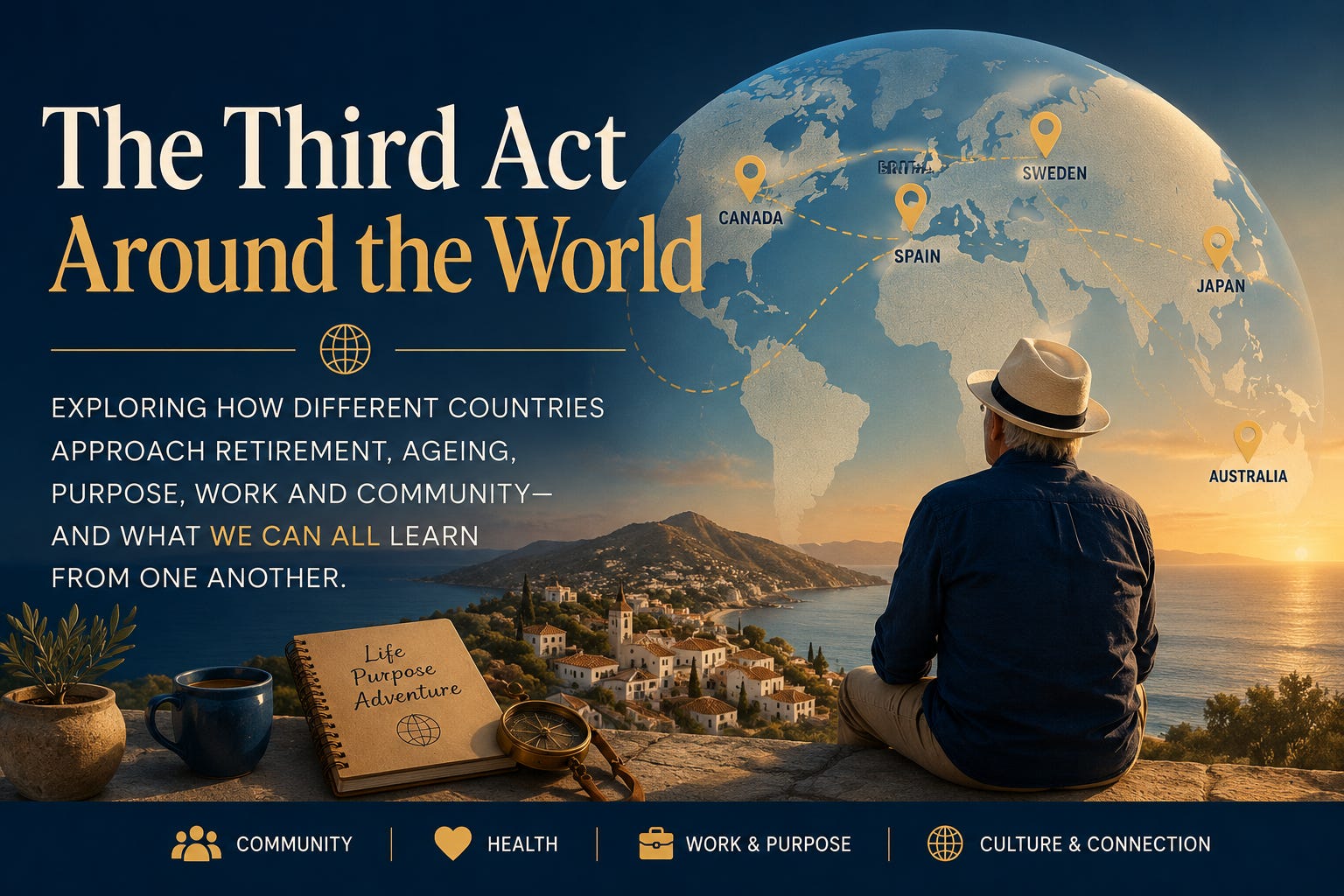
🌍 The Third Act Around the World
International Edition
From sunshine and family life to healthcare and community, what can Britain and Spain learn from each other about growing older?
Retirement does not look the same everywhere.
In Britain, retirement is often imagined as the reward at the end of a long working life. A pension. A bus pass. A few quiet years. Maybe some gardening, television, grandchildren, or a holiday if the money stretches far enough.
But for many people, the reality is more complicated.
Retirement can bring freedom, but it can also bring loneliness. It can bring time, but not always purpose. It can bring rest, but also the uncomfortable question:
What do I do with the rest of my life?
That is why I wanted to begin this new section, The Third Act Around the World, by looking at Britain and Spain.
Spain has long held a powerful place in the British retirement imagination. Sunshine, slower living, outdoor cafés, sea air, community, and the possibility of a different kind of life. For decades, many British retirees have looked at Spain not just as a holiday destination, but as an escape route.
But is retirement in Spain really better?
Or does every country simply have its own version of the same problem?
The British version of retirement
In Britain, retirement is often practical before it is emotional.
Can I afford the bills?
Will the pension be enough?
What happens if I need care?
How long will the NHS take?
Will I be lonely?
Will I still matter?
For many people, Britain offers familiarity and structure. You know the system. You know the language. You know how things work, even when they do not work particularly well.
There is comfort in that.
But there is also a danger.
British retirement can become very small if you are not careful. The same supermarket. The same chair. The same television. The same walk. The same silent house.
For people who live alone, retirement can become less about freedom and more about managing the empty spaces in the day.
The Spanish appeal
Spain offers something Britain often struggles to provide: outdoor life.
Climate changes behaviour. When the weather is warmer, people sit outside. They walk more. They meet in cafés. They linger in public spaces. Life spills out into the street.
That matters.
A person who might feel isolated in a British house in November may feel more connected in a Spanish town square in the evening.
Spain also has a stronger culture of visible social life. Families meet. Older people are seen in public spaces. The rhythm of the day feels less hidden behind closed doors.
That does not mean Spain is perfect, far from it.
Moving country later in life brings serious challenges: language, paperwork, residency rules, healthcare registration, cultural adjustment, and the risk of becoming trapped inside an expat bubble.
Sunshine does not automatically cure loneliness.
But it may change the conditions in which loneliness develops.
Healthcare: security matters
For retirees, healthcare is not a minor detail. It is central.
Britain has the NHS, and for all its problems, many older people still feel emotionally attached to the principle of healthcare based on need rather than wealth.
Spain also has a strong public healthcare system, and many UK pensioners who legally reside in Spain can access Spanish state healthcare through the S1 route.
But this is where dreams meet administration.
Retiring abroad is not simply a matter of buying a plane ticket and sitting in the sun. You need to understand the rules. You need documents. You need to register properly. You need to know what happens if your health changes.
This is where Britain has one advantage: familiarity.
When you are unwell, confused, frightened or older than you expected to become, familiarity has value.
Cost of living: cheaper is not the whole answer
Spain is often seen as cheaper than Britain, especially outside the major cities and tourist hotspots.
That may be true in many cases. Housing, coffee, eating out and local transport can feel more affordable depending on where you live.
But cheaper living is not the same as a better life.
A cheaper life without purpose is still a small life.
A cheaper life without friends is still lonely.
A cheaper life where you cannot speak the language can become isolating.
Money matters. Of course it does. But retirement is not only a financial calculation.
It is also a social, emotional and spiritual one.
Community may be the real difference
The biggest question is not:
Which country has better weather?
The real question is:
Which country makes it easier to stay connected?
This is where Britain needs to ask itself some uncomfortable questions.
Have we designed retirement around isolation?
Have we allowed older people to disappear into houses, flats and care systems?
Have we treated retirement as the end of usefulness rather than the beginning of a different kind of contribution?
Spain may not have all the answers, but its public life offers a useful challenge. Older people are more visible. Social life is more public. The street, the café and the square still matter.
Britain could learn from that.
Not by pretending Preston is Valencia.
Not by pretending a wet Tuesday in Lancashire can become a Mediterranean evening.
But by asking:
How do we bring people back into public life?
How do we make retirement less hidden?
How do we create places where older people can meet without needing a formal group, a medical referral or a crisis?
Purpose after work
This is where both Britain and Spain face the same deeper issue.
People are living longer.
Work is changing.
Families are smaller
, and more spread out.
Technology is replacing jobs.
Communities are weaker than they once were.
So retirement can no longer mean simply stopping.
The third act of life needs a new definition.
It might include creativity.
It might include mentoring.
It might include volunteering.
It might include learning new technology.
It might include caring for others.
It might include starting again.
The question is not simply where we retire.
The question is how we stay alive inside our own lives.
So which country gets it right?
Neither.
And both.
Britain offers familiarity, language, systems and roots.
Spain offers climate, outdoor life, public social spaces and a different rhythm.
But neither country can solve retirement for us unless we also ask what we want our later life to mean.
A person can be lonely in Britain.
A person can be lonely in Spain.
A person can find purpose in Preston.
A person can lose themselves on the Costa del Sol.
The country matters.
But the life we build matters more.
What Britain can learn from Spain
Britain could learn to take public social life more seriously.
We need more places where older people can simply exist around other people.
Not as patients.
Not as problems.
Not as service users.
As citizens.
As neighbours.
As people with stories, skills, humour, memory and value.
What Spain can remind us
Spain reminds us that ageing should not be hidden away.
Older people should be visible.
Conversation matters.
Walking matters.
Sunlight matters.
Community matters.
A slower life is not necessarily a lesser life.
Sometimes it is a more human one.
A small experiment
This article is the first in a new section called The Third Act Around the World.
The aim is simple: to explore how different countries approach retirement, ageing, purpose, work and community — and what we can all learn from one another.
A Spanish version of this article is also available as an experiment.
I do not speak Spanish fluently. The Spanish edition has been carefully adapted with the assistance of AI. The aim is not to pretend to be something I am not. The aim is to start a wider conversation.
If you live in Spain, Britain, or anywhere else, I would love to hear your view.
What does retirement look like where you are?
What does your country get right?
And what does it still get badly wrong?
🌍 Read this article in Spanish
This article is also available in Spanish as part of The Third Act Around the World experiment.
🇪🇸 Spanish edition available
Read this article in Spanish →

This article is the first in a new series exploring retirement around the world.
If you’re reading from outside the UK, I’d love to hear how retirement is experienced where you live.
If this article resonated with you, please consider sharing it with someone who might enjoy the conversation.