

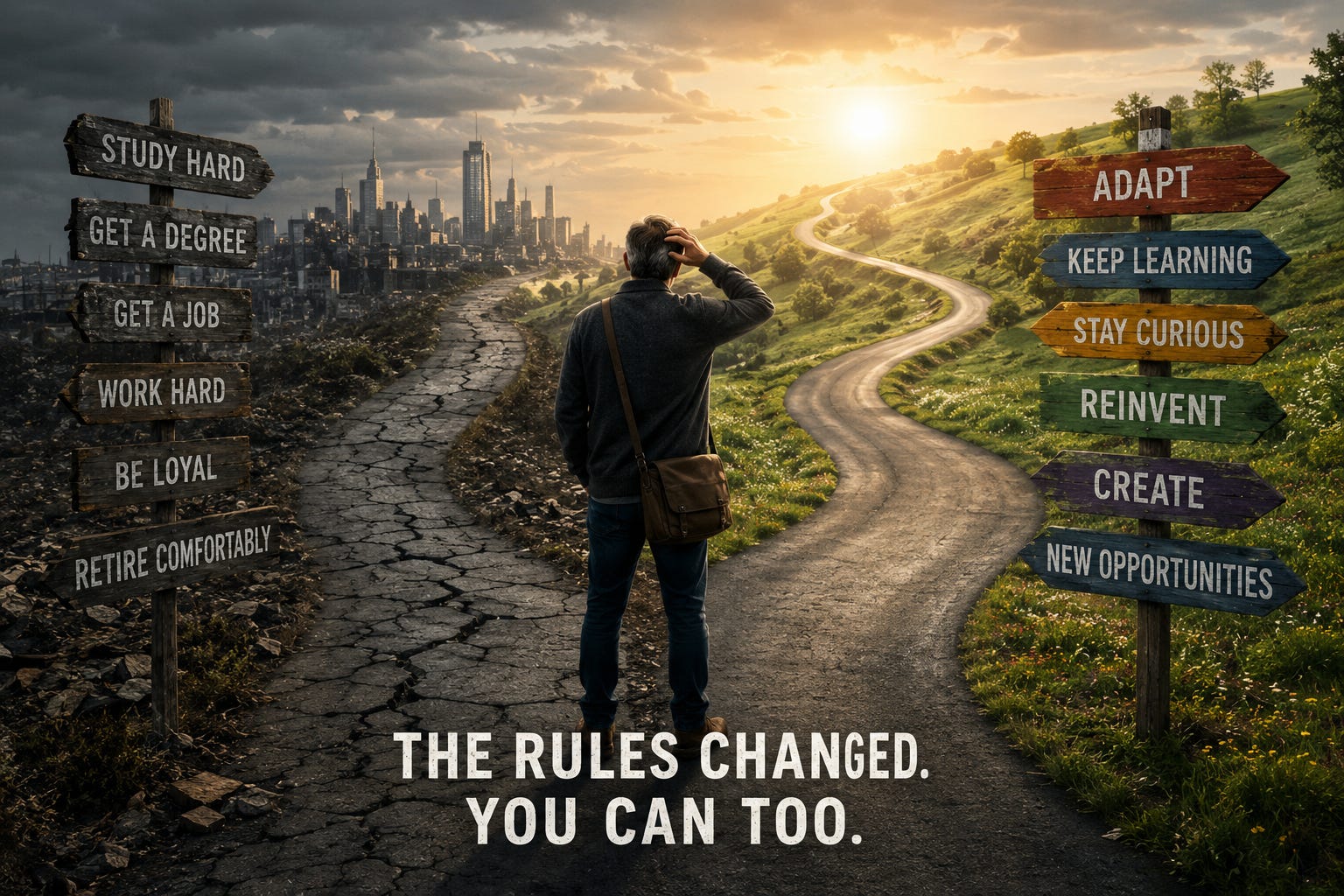
If you’ve read my previous articles, you’ll know I believe many people aren’t struggling because they failed.
They’re struggling because the world changed faster than anyone expected.
The career advice that worked for our parents doesn’t always work today.
A degree is still valuable.
Experience still matters.
Hard work is still important.
But they are no longer enough on their own.
Today’s world rewards adaptability.
That might sound intimidating, but it can also be incredibly liberating.
Reinvention isn’t about becoming someone else.
It’s about discovering what else you’re capable of.
Here are seven practical steps that anyone can begin today.
1. Accept That the World Has Changed
This isn’t about giving up.
It’s about seeing reality clearly.
Many people spend years waiting for things to “go back to normal.”
History tells us they rarely do.
Every major technological shift has created winners and losers, but the people who adapted earliest were usually those who accepted change rather than resisted it.
The sooner you accept that the rules have changed, the sooner you can start writing your own.
2. Become a Student Again
School taught us that learning ends.
Life teaches us that it doesn’t.
You don’t need another expensive degree.
Start with one skill.
Learn how to edit video.
Understand artificial intelligence.
Take photographs.
Write.
Build a website.
Learn basic coding.
Master spreadsheets.
Study public speaking.
Choose something that genuinely interests you.
Spend just thirty minutes each day learning it.
Small steps become remarkable progress over time.
3. Stop Thinking About Jobs. Start Thinking About Skills
Jobs come and go.
Skills stay with you.
Instead of asking,
“What job should I do?”
Ask,
“What useful skills can I develop?”
Writing.
Communication.
Problem-solving.
Teaching.
Organisation.
Creativity.
Leadership.
These are skills that transfer across industries.
The more versatile your skills become, the more adaptable you become.
4. Work With Artificial Intelligence—Not Against It
Many people fear AI because they see it as competition.
I see it differently.
Artificial intelligence is becoming one of the most powerful tools ordinary people have ever had.
It can help you write.
Brainstorm ideas.
Learn faster.
Create presentations.
Design images.
Edit videos.
Translate languages.
Research topics.
The people who benefit most won’t necessarily be technology experts.
They’ll be people who learn how to combine their life experience with new technology.
Experience provides judgement.
AI provides speed.
Together, they’re a powerful combination.
5. Build Something That Belongs to You
For years, many of us built careers around someone else’s business.
Today, it’s easier than ever to create something of your own.
Start a blog.
Write on Substack.
Create videos.
Sell digital products.
Share your expertise.
Teach what you’ve learned.
You don’t need millions of followers.
You need consistency.
Creating something that’s yours builds confidence as well as opportunity.
6. Look After the Person Doing the Learning
Reinvention isn’t only intellectual.
It’s physical and emotional too.
Poor sleep makes learning harder.
Stress reduces creativity.
Isolation affects confidence.
Exercise improves thinking.
Walking stimulates ideas.
Conversations create opportunities.
Looking after your health isn’t separate from building your future.
It’s part of it.
The healthier you are, the easier it becomes to adapt.
7. Stay Curious
If I had to choose one quality that matters most in the years ahead, it wouldn’t be intelligence.
It would be curiosity.
Curious people ask questions.
They experiment.
They aren’t embarrassed to be beginners.
They understand they won’t know everything, and they’re comfortable with that.
Curiosity keeps you moving when certainty disappears.
It turns fear into exploration.
And it reminds you that every expert was once someone who knew absolutely nothing.
The Best Time to Start Is Now
Many people believe reinvention has an age limit.
I don’t.
I’ve met people who discovered painting in retirement.
Others started writing.
Some launched businesses in their sixties and seventies.
Others embraced technology they once believed was beyond them.
They weren’t chasing youth.
They were embracing possibility.
Perhaps that’s the real lesson.
Reinvention isn’t about becoming younger.
It’s about refusing to stop growing.
The world will continue to change.
Artificial intelligence will become more capable.
Careers will continue to evolve.
Some jobs will disappear.
Others haven’t even been invented yet.
We can’t control all of that.
What we can control is our willingness to learn.
Maybe the future doesn’t belong to the youngest.
Maybe it belongs to those who never lose their curiosity.
And perhaps the most important qualification any of us can earn is the one that isn’t printed on a certificate.
The willingness to begin again.
A simple challenge
Choose one new skill you’ve always wanted to learn.
Spend just 30 minutes on it today.
Not tomorrow.
Today.
Then do the same tomorrow.
You might be surprised where those small steps lead a year from now.
If this article encouraged you, please share it with someone who may be wondering what comes next. Restack it if you’re reading on Substack, and subscribe for more reflections on work, technology and thriving in a rapidly changing world.