

Back in 1972, the British rock band Slade released a song called “Mama Weer All Crazee Now.”
It was loud, rebellious and unforgettable.
It wasn’t trying to explain society.
It was simply a brilliant rock song.
But more than fifty years later, I find myself thinking about that title in a very different way.
Mama... have we all gone crazy now?
Not in the sense of mental illness.
That’s not what this article is about.
I’m asking something much broader.
Has modern life quietly changed the way we think, behave and relate to one another?
Retirement gave me an unexpected gift
When I retired, I expected more free time.
I expected slower mornings.
Longer walks.
The chance to finally do the things I’d put off for years.
What I didn’t expect was to become an observer.
For decades I lived at the same pace as everyone else.
Wake up.
Go to work.
Drive home.
Eat.
Sleep.
Repeat.
There wasn’t much time to simply stop and watch the world.
Retirement changed that.
Now I find myself sitting in cafés with a cup of coffee, watching people go about their lives.
And the more I watch, the more questions I have.
Things I never noticed before
Perhaps they’ve always been there.
Perhaps I’m only noticing them because life has slowed down.
I see people walking through town talking to themselves.
Some may be speaking through wireless earbuds.
Some may simply be thinking out loud.
Some may be rehearsing a difficult conversation.
Some may be trying to make sense of something that’s happened in their lives.
Before I go any further, I want to be clear.
Talking to yourself isn’t, by itself, a sign of mental illness.
Many people think aloud.
Many people solve problems that way.
Many people rehearse conversations before they happen.
This article isn’t about diagnosing anyone.
It’s about something else entirely.
It made me wonder why our first reaction is often to judge rather than to understand.
Why do we feel uncomfortable when someone behaves differently?
Why are we so quick to attach labels to people whose stories we know nothing about?
Perhaps the better question isn’t what’s happening to them.
Perhaps it’s what’s happening to us.
The private worlds we create
Then I noticed something else.
People sitting together in cafés.
Not talking.
Couples looking at separate phones.
Families sharing a meal while each person disappears into a different screen.
People waiting for buses with headphones on, sealed inside their own little worlds.
We’ve never had more ways to communicate.
Yet many people seem lonelier than ever.
It’s a strange contradiction.
We carry the world in our pockets.
Yet many of us struggle to connect with the person sitting beside us.
Have we built a world our minds weren’t designed for?
The news never stops.
Social media never sleeps.
Notifications arrive every few minutes.
Every day we’re expected to absorb more information, more opinions and more anxiety than any previous generation.
Perhaps we’re not becoming crazier.
Perhaps we’re becoming overwhelmed.
Perhaps those little private worlds we create are simply places where we can catch our breath.
Where nobody judges us.
Where nobody interrupts us.
Where, for just a moment, life becomes quieter.
What happened to community?
I remember neighbours talking over garden fences.
People chatting while waiting for a bus.
Children playing outside until it started getting dark.
I’m not pretending the past was perfect.
It wasn’t.
Every generation has its problems.
But I do wonder if we’ve quietly traded something valuable.
Conversation for convenience.
Community for connection.
Neighbours for notifications.
Technology has given us incredible opportunities.
But has it also made it easier to drift apart?
Maybe retirement changes what we notice
One of retirement’s greatest gifts isn’t time.
It’s perspective.
When life slows down, you begin to notice things.
The lonely man who orders the same coffee every morning.
The young mother trying to comfort an exhausted child.
The older couple who still hold hands.
The teenager who helps someone cross the road without being asked.
The person quietly talking to themselves.
You begin to realise something important.
Every person you pass is carrying a story you’ll probably never know.
Perhaps instead of judging them, we should become more curious.
Perhaps instead of assuming the worst, we should choose compassion.
Why I started The Third Act
People sometimes ask why I started writing these articles.
The answer is simple.
Retirement gave me time to ask questions I’d never slowed down enough to ask before.
Questions about purpose.
About ageing.
About community.
About loneliness.
About technology.
About what it means to live a meaningful life in a world that’s changing faster than many of us can keep up with.
I don’t pretend to have the answers.
I’m simply inviting you to explore the questions with me.
Because I suspect I’m not the only one who’s been wondering.
So... have we all gone crazy?
I don’t think so.
I think we’ve built a fast, noisy and demanding world.
A world where many people feel unseen.
A world where genuine conversations are becoming rarer.
A world where loneliness can exist in the middle of a crowd.
Perhaps what we need isn’t more technology.
Or more opinions.
Or more noise.
Perhaps what we need is to slow down.
To notice one another.
To be less quick to judge and more willing to understand.
Maybe that’s what The Third Act is really about.
Not just finding purpose after retirement.
But rediscovering our curiosity about the world...
...and our compassion for the people we share it with.
I’d love to hear your thoughts.
What have you noticed about modern life that feels different from twenty or thirty years ago?
Not because the past was perfect.
But because sometimes looking back helps us understand where we’re going.
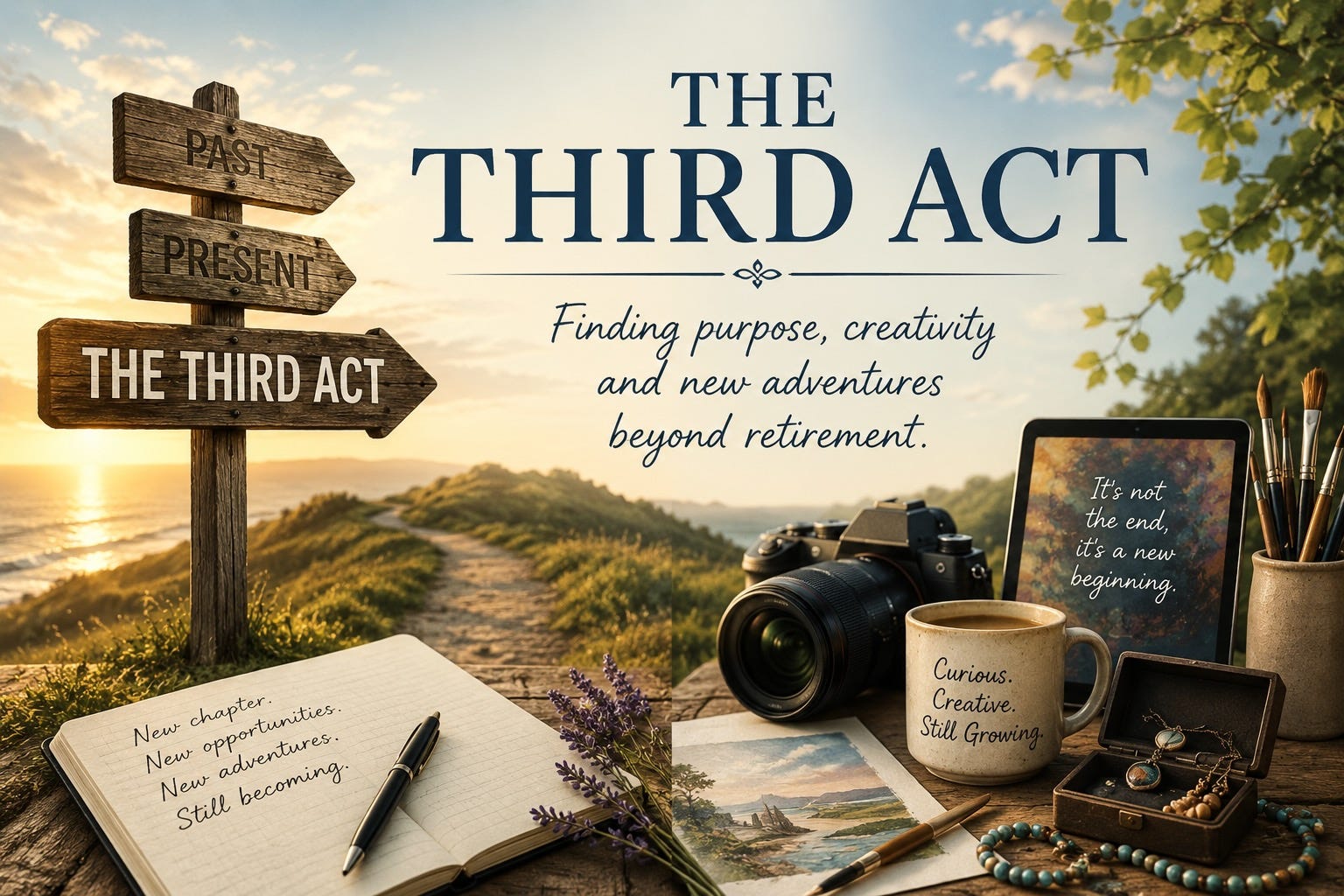
If this article made you stop and think, please share it with someone who enjoys asking questions about the world around them, restack it so more people can join the conversation, and subscribe to The Third Act as we continue exploring purpose, creativity and new adventures beyond retirement.
Because every journey begins with a question.