

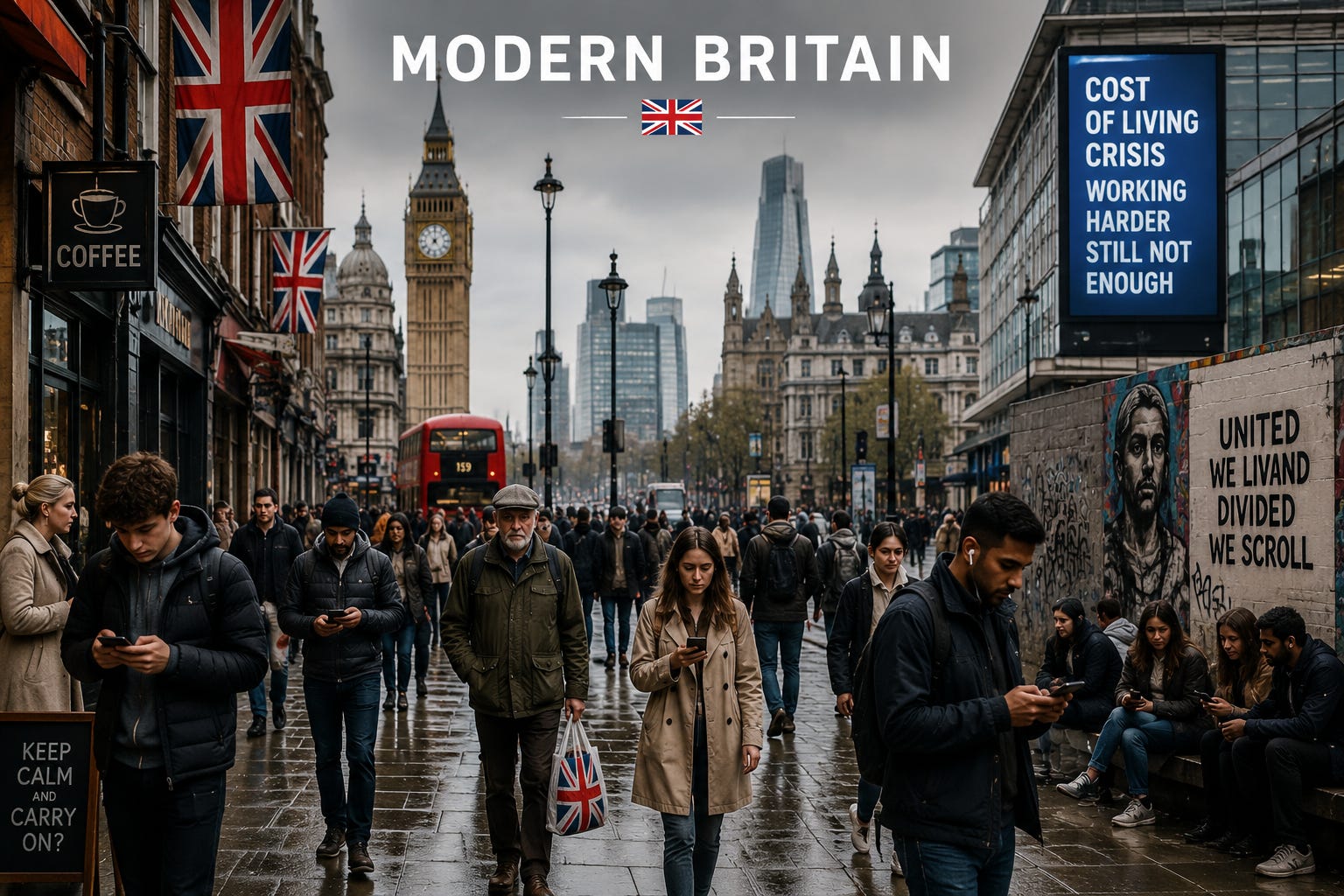
I’ve been thinking about publishing this article for some time, and I believe it’s a conversation worth having.
I thought long and hard before writing it. Not because it is political, but because it touches on issues that many people feel strongly about.
Like many others, I’ve watched the changes taking place across Britain in recent years and found myself asking questions about how we communicate, how we disagree, and whether we are becoming less willing to listen to one another.
This article is not intended to tell anyone what to think. It is simply an observation from one person trying to make sense of the world around him and to ask whether open conversation has become harder than it used to be.
Before I begin, I want to make something clear.
This is not a political statement.
It is not an argument for the left or the right. It is not an endorsement of any party, politician, movement, or ideology.
It is simply an observation.
An observation about people.
An observation about society.
And an observation about something that feels different today than it did years ago.
I sometimes wonder whether we have become uncomfortable with asking questions.
Not challenging for the sake of challenging.
Not arguing for the sake of arguing.
Simply asking questions.
Questions are how we learn. They are how we understand the world. They are how we test ideas and challenge assumptions.
Yet increasingly it feels as though asking a question can place you into a camp you never intended to join.
Question one thing and you are labelled one way.
Question something else and you are labelled another.
The conversation often ends before it has even begun.
Perhaps that is what troubles me most.
Not that people disagree.
Disagreement has always existed.
The real concern is that disagreement increasingly feels like conflict rather than conversation.
Somewhere along the way we seem to have lost the ability to say:
“I see it differently.”
Instead we are encouraged to choose sides.
We are expected to be certain.
To have an opinion immediately.
To know exactly where we stand.
But what if we are unsure?
What if we are still thinking?
What if we simply want to explore an idea without being assigned to a tribe?
Social media has undoubtedly accelerated this process.
Complex issues are reduced to a few words.
Nuance disappears.
The loudest voices often receive the most attention.
Certainty is rewarded.
Doubt is viewed with suspicion.
Curiosity is mistaken for opposition.
The result is that many people stay silent.
Not because they have nothing to say.
But because they are tired of the arguments that follow.
I see this in everyday life.
Among friends.
Within families.
In workplaces.
Online communities.
People who once would have discussed an issue over a cup of tea now avoid the conversation entirely.
Not because they hate each other.
Because they fear what the conversation might become.
That strikes me as a loss.
A society does not become stronger when everyone thinks the same way.
It becomes stronger when different people can discuss difficult subjects respectfully.
When questions are welcomed.
When uncertainty is acceptable.
When changing your mind is seen as wisdom rather than weakness.
Perhaps every generation believes society is changing.
Perhaps this is simply another stage in that process.
But I cannot help wondering whether we are losing something important.
Not freedom of thought.
Not freedom of speech.
But something even more basic.
The willingness to listen.
The willingness to question.
And the willingness to accept that intelligent, decent people can look at the same situation and reach different conclusions.
Maybe the issue is not whether the narrative is right or wrong.
Maybe the issue is whether we still feel able to examine it.
Because a healthy society is not built upon agreement.
It is built upon conversation.
And the conversation begins with a simple question.
“What do you think?”