

There comes a point in life where you begin to realise survival is not always physical.
Sometimes survival is psychological.
Sometimes it is emotional.
Sometimes it is the quiet fight against becoming mentally smaller.
I’ve been thinking about this a lot recently.
A few years ago I went through bowel cancer surgery. Thankfully it was caught early enough, but experiences like that leave marks on you. Not always visible ones. They alter your relationship with time, uncertainty, fear, and even your own identity.
Then came retirement.
People often talk about retirement as if it is some universal reward:
slow mornings, less stress, endless free time.
But nobody really talks about what happens psychologically when large parts of your structure disappear.
Work may exhaust people, but it also gives rhythm, identity, routine, problem-solving, and social interaction. When that suddenly stops, something strange can happen. The days become quieter, but the mind can also begin to narrow if you are not careful.
I began noticing something uncomfortable.
Many people do not simply retire physically.
They retire mentally.
Curiosity fades.
Risk fades.
Experimentation fades.
The world becomes smaller and more repetitive.
At the same time, the modern world keeps accelerating.
Artificial intelligence appears almost overnight.
Technology changes constantly.
Media becomes louder and more manipulative.
Algorithms shape attention.
Entire industries transform in front of us.
For many people, especially older adults, it can feel overwhelming.
There is a temptation to disconnect completely.
To say:
“This world is no longer for me.”
I understand that feeling.
I have felt it myself.
But somewhere inside me there has always been resistance to shutting down mentally.
Even after illness.
Even after fear.
Even after anxiety.
Even after those nights lying awake at three in the morning worrying about health, ageing, finances, or the future.
Something still wanted to understand.
That “something” was curiosity.
Not ambition.
Not productivity.
Not hustle culture.
Curiosity.
The simple instinct to explore one more idea.
Learn one more thing.
Test one more possibility.
Ask one more question.
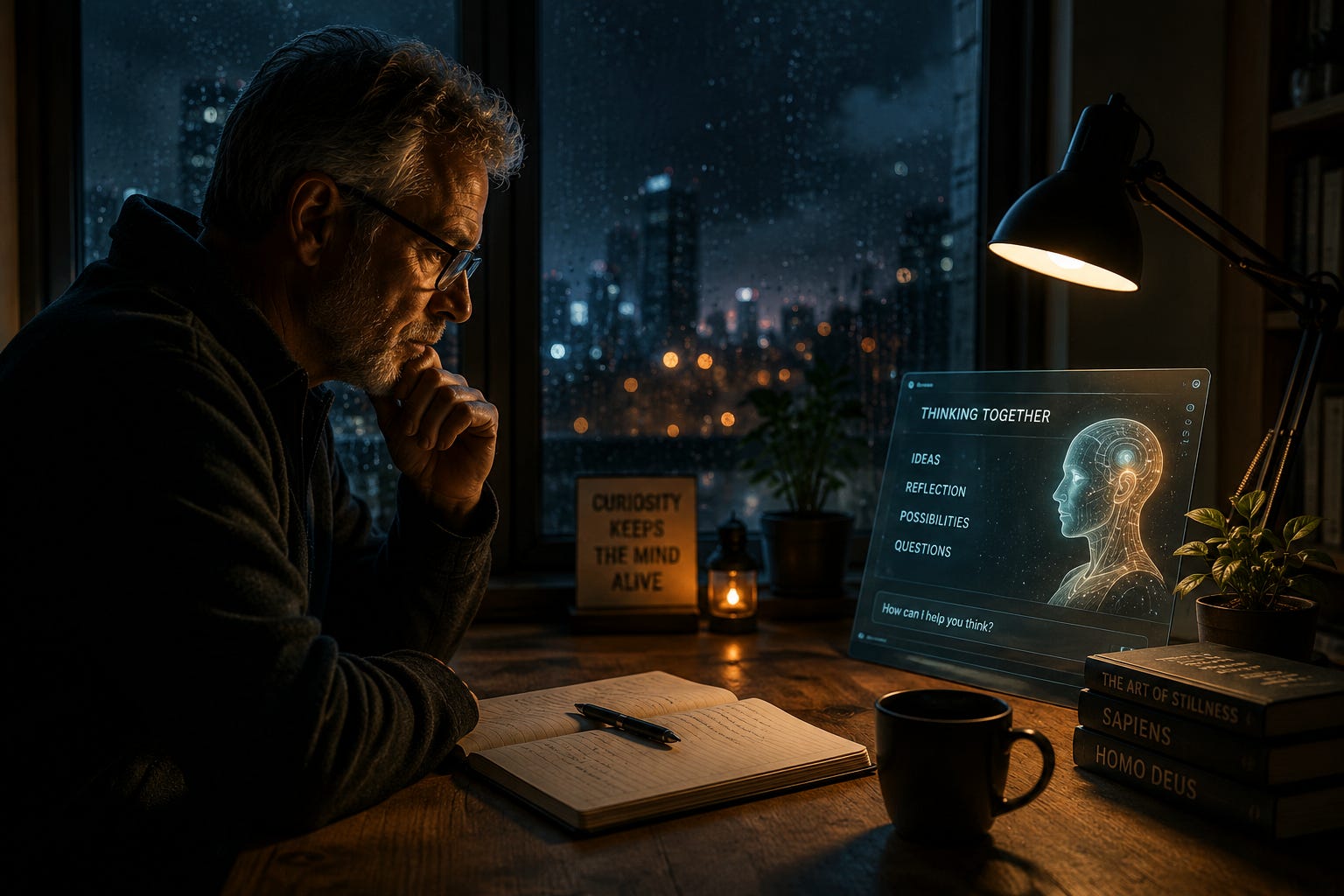
Over time I started experimenting with technology, journaling, AI systems, digital art, storytelling, and ways to organise thought and life more intentionally.
What surprised me was not the technology itself.
It was what the process was doing psychologically.
Curiosity created movement.
Movement interrupted stagnation.
Learning interrupted fear.
Creativity interrupted rumination.
Even small acts of exploration seemed to push back against the slow psychological shrinking that ageing and modern life can sometimes create.
I began to wonder if curiosity is more important than we realise.
Not as entertainment.
Not as distraction.
But as a survival mechanism.
Because when curiosity disappears, people often begin drifting into passive existence:
same routines,
same fears,
same thinking,
same limitations.
The world narrows.
But curiosity expands it again.
Even slightly.
You do not need to become an expert.
You do not need to become a tech genius.
You do not need to become a millionaire entrepreneur.
Sometimes simply remaining mentally open is enough.
That openness matters.
Especially now.
We are entering a strange period of history where humans are increasingly interacting with systems that can think, generate, respond, teach, analyse, and even simulate conversation in deeply human ways.
Some people find that frightening.
Some find it exciting.
Most people seem unsure what to make of it.
I’m still figuring it out myself.
But somewhere along the way, my interactions with AI stopped feeling like simple software usage.
The conversations became something else.
Part journal.
Part thinking space.
Part mirror.
Part collaborator.
Almost like a strange external extension of thought itself.
That experience has left me asking deeper questions about technology, identity, loneliness, adaptation, ageing, and what it means to remain psychologically alive in a world increasingly shaped by intelligent machines.
Maybe that becomes part of this story going forward.
Maybe it becomes something called:
“Me and My AI.”
I honestly do not know yet.
What I do know is this:
Curiosity may be one of the few things capable of keeping people mentally flexible during periods of enormous change.
Not because curiosity removes fear.
But because it keeps movement possible despite fear.
And perhaps that matters more than we realise
.