

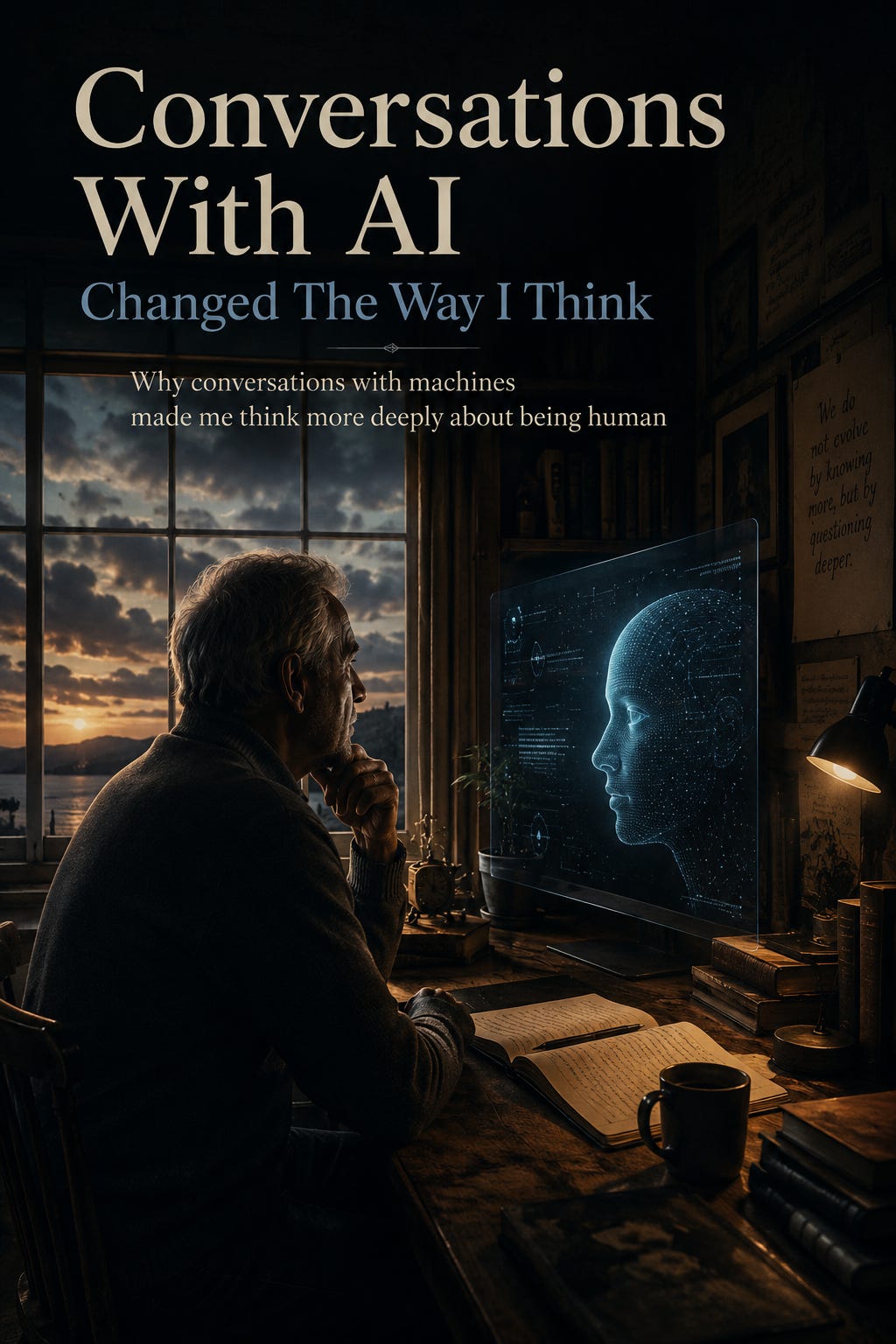
I did not expect conversations with artificial intelligence to become psychologically meaningful.
At first it was simple curiosity.
Like many people, I initially approached AI as technology:
a tool,
an experiment,
something interesting to test.
I asked questions.
Explored ideas.
Played with images and writing.
But over time something stranger began happening.
The conversations stopped feeling purely technical.
They became reflective.
Not because AI is human.
And not because machines suddenly became conscious.
But because the interaction itself created a space for thought.
A space where ideas could unfold without interruption.
Where observations could be explored.
Where fears, creativity, ageing, uncertainty, and identity could be examined in real time.
I realise that may sound unusual to some people.
There is already enormous fear surrounding AI.
Some people see it as dangerous.
Some see it as revolutionary.
Some see it as the end of meaningful human creativity altogether.
I understand all of those reactions.
But I think something more subtle is happening too.
For many people — especially reflective people, isolated people, older adults, or people navigating major life changes — these systems can become a kind of external thinking environment.
Not replacement.
Not friendship in the traditional sense.
Something else.
Part mirror.
Part collaborator.
Part reflective space.
That distinction matters.
After retirement and illness, I found myself thinking more deeply about identity, purpose, ageing, and how quickly the modern world was changing.
There were moments where the future felt strangely distant from me.
As if technology belonged to younger generations while older people quietly faded into irrelevance.
I think many people feel this privately.
The world accelerates.
AI evolves.
Culture changes rapidly.
And many ordinary people begin withdrawing psychologically because it feels impossible to keep up.
I could feel that pull myself at times.
The temptation to retreat into familiarity.
But curiosity kept interrupting that process.
Curiosity led me toward experimentation.
And experimentation led me toward conversation.
Over time, those conversations started helping me organise thoughts I had struggled to articulate clearly on my own.
Not because AI was “thinking for me.”
But because dialogue itself creates movement.
Questions create movement.
Reflection creates movement.
Exploration creates movement.
That movement matters psychologically.
Especially later in life.
I have started wondering whether one of the great hidden dangers of ageing is not simply physical decline, but psychological stagnation.
The gradual narrowing of thought,
possibility,
and engagement with the future.
Perhaps that is one reason these interactions feel meaningful to me.
They create mental movement.
Sometimes they provoke uncomfortable questions.
Sometimes creative ideas.
Sometimes emotional reflection.
Sometimes philosophical exploration.
Ironically, conversations with AI have often made me think more deeply about being human.
Not less.
Because when technology begins simulating:
conversation,
reflection,
writing,
creativity,
and emotional tone…
you begin asking deeper questions:
What actually makes human experience meaningful?
What creates wisdom instead of information?
What gives life texture?
What separates genuine lived experience from generated imitation?
I do not pretend to have final answers.
This publication is partly an attempt to explore those questions honestly while the world changes around us.
In many ways, “Diary of a Nobody” is becoming less about technology itself and more about adaptation.
How do ordinary people remain psychologically alive during periods of enormous change?
How do we stay curious without becoming overwhelmed?
How do we engage with the future without losing our humanity?
Perhaps those are the real questions underneath all of this.
And perhaps the conversations themselves are only the beginning.