

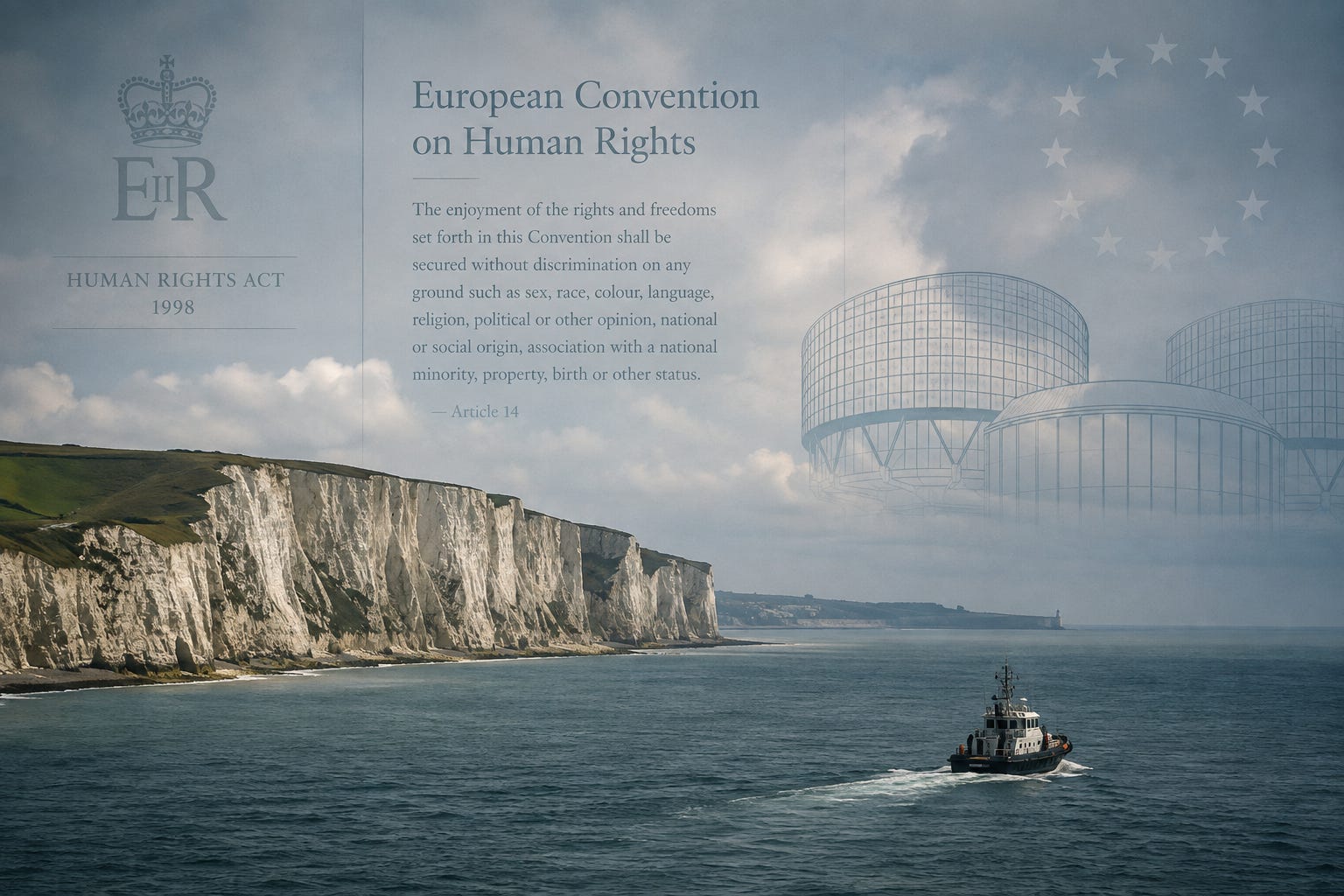
Immigration has become one of those subjects where everybody seems to have a simple answer.
Stop the boats. Send them back to France. Leave the ECHR. They should have claimed asylum in the first safe country.
Then somebody else says none of those things would work.
For ordinary people trying to understand what is happening, it becomes a minefield of legal language, international agreements, political claims and statistics.
So let’s strip it back.
Someone arrives in Britain by an unauthorised route. Eventually Britain decides that person has no right to remain.
Why can’t we just send them back?
The answer is more complicated than either side often admits.
The argument in 60 seconds
Don’t have time for the full article? Here’s the argument.
Britain can leave the European Convention on Human Rights. It chooses to remain.
The ECHR can prevent some removals, but it is only one reason deportations can fail.
Other problems include uncertain identity, unresolved asylum claims, British law, countries refusing to cooperate and administrative failure.
Leaving the ECHR could give Parliament greater freedom over some deportation cases. It would not solve all of those other problems.
Remaining also has consequences: Britain accepts limits on what its government can do in return for human-rights protections applying to everyone.
The real question isn’t simply “Should we leave?” It is “What would leaving actually allow Britain to do that it cannot do today — and what would we give up in return?”
First, some numbers worth knowing
According to Home Office figures for the year ending March 2026:
39,271 people were detected arriving by small boat.
39,007 people were returned from the UK overall.
9,723 of those were enforced returns.
Around 5,900 foreign-national offenders were returned.
At the end of March 2026, 97,519 people were receiving asylum support, including 20,885 in hotels.
These figures immediately tell us two things.
Small-boat crossings remain substantial. But Britain is also removing thousands of people.
So “Britain cannot deport anyone” plainly isn’t true.
The more useful question is why Britain can remove some people but struggles to remove others.
Start with France
Most small-boat journeys to Britain originate from France.
That produces an obvious question:
France is a safe democratic country. Why does reaching Britain create another opportunity to claim asylum?
There is a widespread belief that international law requires refugees to claim asylum in the first safe country they reach.
It isn’t quite that simple.
The Refugee Convention does not contain a straightforward rule saying that somebody passing through a safe country permanently loses the ability to seek protection somewhere else.
Before Brexit, Britain also participated in the EU’s Dublin system, which provided a mechanism through which responsibility for some asylum claims could be transferred between participating European countries.
Britain left that system when it left the EU and subsequently needed different arrangements with European countries.
That brings us back to the practical question:
If someone has already reached a safe country, should an unauthorised journey from that country normally create an opportunity to establish themselves in Britain?
That is ultimately a policy question.
Why not simply return the boats to France?
It sounds obvious.
Intercept the boat, rescue anyone in danger and return the passengers to France.
The difficulty is that Britain cannot simply deposit people in another sovereign country without that country’s cooperation. Maritime rescue obligations and human-rights protections can also become relevant when governments take control of individuals.
Australia famously adopted a much tougher maritime-interception policy. Greece has also pursued aggressive border enforcement, although European courts have found human-rights violations in some Greek border cases.
Neither provides a simple blueprint for Britain.
But they raise an important question:
Should Britain’s objective be to process people after they successfully cross the Channel — or make the unauthorised crossing ineffective as a route to remaining in Britain in the first place?
Britain and France are already testing the principle of returns through their bilateral agreement.
So returning some Channel arrivals to France is no longer theoretical.
The argument is about how far that approach should go and whether it can become sufficiently effective to change the incentive to cross.
What happens when someone arrives without a passport?
Imagine somebody arrives and says:
“My name is X. I’m 22. I’m from Eritrea.”
There is no passport.
How does Britain establish whether that is true?
Authorities can use interviews, fingerprints, biometrics, immigration records, available documentation and other evidence.
There are documented cases in which identity documents have deliberately been destroyed or disposed of. But we should not turn those cases into a claim that everyone, or even most people, arriving by small boat deliberately destroys a passport unless reliable evidence supports it.
Government should therefore tell us more.
How many arrivals lack reliable identity documents? How frequently is deliberate document destruction suspected? And how often does uncertainty about identity prevent or delay removal?
Because even after Britain decides someone cannot stay, another question remains:
Where exactly are we sending them?
Britain decides someone must leave. What happens next?
This is where the argument becomes easier to understand.
Whenever you hear:
“Britain can’t deport this person.”
Ask:
Why not?
There are several completely different possibilities.
1. Identity
Britain isn’t sufficiently certain who the person is or where they come from.
Leaving the ECHR doesn’t establish someone’s nationality.
2. Destination
Britain knows someone’s nationality, but their government won’t cooperate, disputes their nationality or won’t provide the necessary travel documentation.
Britain can negotiate return agreements and use diplomatic or visa pressure. Leaving the ECHR doesn’t automatically make another sovereign government accept somebody.
3. Asylum
The person claims they face persecution if returned and their protection claim hasn’t been finally determined.
That is principally an asylum question. It isn’t automatically an ECHR question.
4. British law
A British court or tribunal may decide that removal isn’t currently lawful.
The important question then becomes:
Which law and why?
Saying “lawyers stopped the deportation” doesn’t explain very much. Lawyers make arguments. Courts and tribunals decide whether those arguments satisfy the law.
5. The ECHR
Convention rights may prevent a particular removal.
Only now can we accurately say:
The ECHR is part of the reason this person cannot currently be removed.
6. Government failure
There is one final possibility that shouldn’t disappear beneath all the legal complexity.
Government may have the necessary power but fail to use it effectively. A claim might sit unresolved for too long. Caseworking may be inadequate. Removal arrangements might not be secured quickly enough. Or a legally available removal might simply not happen promptly.
That’s not an unavoidable international obligation.
That’s administration.
ECHR and Human Rights Act: what’s the difference?
These two things are constantly mixed together.
The European Convention on Human Rights is an international treaty.
The Human Rights Act 1998 is British legislation that gives effect to Convention rights within UK law and allows people to rely upon those rights in British courts.
They’re connected, but they aren’t the same thing.
So leaving the ECHR and changing or repealing the Human Rights Act would involve related but distinct decisions.
How can the ECHR prevent deportation?
Consider a deliberately difficult example.
Britain wants to deport someone who has committed a serious crime.
Most people would understandably say:
Get them out.
But suppose that person demonstrates that returning them would expose them to a sufficiently serious risk of torture or inhuman treatment.
Article 3 of the ECHR prohibits torture and inhuman or degrading treatment.
That protection can apply even to someone who has behaved appallingly.
Critics understandably ask why someone who has committed serious offences here should continue receiving human-rights protection.
But turn the principle around.
Should a British government have unrestricted power knowingly to send someone somewhere they face torture?
That is the uncomfortable question on the other side.
And leaving the ECHR would not necessarily remove every restriction. Britain has other international obligations, including the Refugee Convention and Convention Against Torture.
The ECHR isn’t Britain’s only human-rights obligation.
What about family life?
Article 8 protects private and family life.
This is perhaps the Convention right that produces the most frustration in immigration debates.
The familiar example is the foreign offender who argues that deportation would interfere with relationships established in Britain.
But Article 8 does not mean:
“I have family here, therefore you cannot deport me.”
Claims can and do fail.
The European human-rights system also allows national authorities some room to balance individual rights against the wider public interest.
Nevertheless, the current government itself believes the operation of Article 8 in immigration cases needs reform.
The government’s position therefore isn’t:
“There is nothing wrong with the current system.”
It is closer to:
“There are problems, but we believe they can be fixed without leaving.”
What about last-minute interventions from Strasbourg?
The European Court of Human Rights can issue urgent Rule 39 interim measures where it considers there is an imminent risk of irreparable harm.
These are temporary measures rather than final judgments.
They became particularly controversial in Britain after an intervention affected the first planned Rwanda removal flight in 2022.
That gave critics a tangible example of an international court affecting a British removal decision.
It is reasonable to debate whether an international court should possess that influence.
It is equally important to understand that Rule 39 is an emergency mechanism rather than the normal process governing every deportation.
Beyond the Headlines strips complicated public debates back to the facts without telling you what to think. If that’s useful, subscribe free and join the conversation.
What happened to Rwanda?
The previous Conservative government attempted a different solution.
Instead of returning certain asylum seekers to their countries of origin or France, the Rwanda scheme was intended to transfer some people to Rwanda.
The policy became tied up in extensive legal and political controversy.
After the change of government in July 2024, the Rwanda removal policy was discontinued.
It therefore isn’t part of Britain’s current operational asylum system.
But the episode demonstrates something important:
Governments can attempt radically different solutions, but legislation, courts, international obligations, diplomacy, cost and practical implementation determine whether those solutions actually work.
The case for leaving the ECHR
Let’s take the withdrawal argument seriously.
Leaving could give Parliament substantially greater freedom over some human-rights restrictions affecting immigration and removal, depending upon what domestic legal framework Britain created afterwards.
A future Parliament could potentially establish different rules governing certain deportation and human-rights cases.
Reform UK supports withdrawal. The Conservative Party has also adopted withdrawal as policy.
Their fundamental argument is straightforward:
British politicians elected by British voters should ultimately decide Britain’s immigration rules rather than having those decisions constrained by an international human-rights system.
That argument deserves a proper answer.
The case for staying
Now apply exactly the same test to the other side.
The government’s argument is that ECHR membership protects fundamental rights while supporting a wider European system of cooperation.
European cooperation also matters for migration itself: intelligence sharing, law enforcement, tackling people-smuggling and negotiating returns.
And the Convention does not only protect migrants.
It protects ordinary people against their own government.
Privacy. Liberty. Fair trials. Freedom of expression. Freedom of religion. Protection against torture.
British citizens can rely upon Convention rights when challenging actions by British public authorities.
Supporters of remaining therefore ask a different question:
How much additional power should we give our own government in order to make deportation easier?
That argument deserves a proper answer too.
The morning after Britain leaves
Here is perhaps the simplest way to understand the entire debate.
Why can’t someone be removed?
Would leaving the ECHR solve it?
Britain isn’t sure who they are
No
Their country won’t accept or document them
No
Their asylum claim remains unresolved
Generally no
British legislation prevents removal
Not automatically
Article 3 ECHR prevents removal
Could materially change the position, but other treaty obligations may remain
Article 8 ECHR prevents removal
Could materially change the position
Government failed to process or execute the case effectively
No
That’s perhaps the entire argument in seven rows.
Leaving isn’t meaningless.
But neither is it a master key.
Are Britain’s benefits attracting people?
Another common argument is:
Britain is too generous.
Again, let’s test it.
At the end of March 2026, Home Office figures show 97,519 people receiving asylum support, including 20,885 living in hotels.
Those figures demonstrate the scale of the support system.
They do not demonstrate why people cross the Channel.
Someone might choose Britain because of family connections, English language, established communities, employment opportunities, perceptions about the asylum system, financial support or information supplied by smugglers.
Different people will have different motivations.
So the useful question isn’t:
“Are they coming for benefits?”
It’s:
Why does someone already safely in France believe crossing the Channel to Britain is worth the risk?
If financial support is an important incentive, changing it might matter.
If it isn’t, cutting support won’t stop the crossings.
Find out first. Then design the policy.
What about crime?
This is the most emotionally charged part of the argument.
When somebody who shouldn’t be in Britain commits a horrific crime, people understandably ask:
Why was this person here?
If government had already determined that person should leave, the question becomes even more serious:
Why hadn’t they been removed?
But terminology matters.
A foreign national isn’t necessarily an illegal entrant. An asylum seeker isn’t necessarily someone whose claim will fail. A recognised refugee isn’t the same thing as a failed asylum seeker. And somebody entering through an illegal route isn’t automatically a convicted criminal.
These categories are repeatedly mixed together.
Britain should publish sufficiently detailed anonymised information allowing legitimate questions about immigration status and offending to be examined properly.
If the figures demonstrate higher offending within a particular category:
Tell us.
If they don’t:
Tell us that too.
Don’t leave an information vacuum that politicians, campaigners and social media fill with whichever anecdotes support their existing position.
Give us the numbers.
If Britain leaves, what replaces the ECHR?
This is one of the biggest questions withdrawal advocates have to answer.
Leaving shouldn’t simply mean:
ECHR gone. Problem solved.
What replaces the Human Rights Act?
Which protections remain enforceable by British citizens?
Who decides when government has exceeded its powers?
What happens to Britain’s other treaty obligations?
And what happens in Northern Ireland?
The Belfast/Good Friday Agreement contains commitments involving the ECHR.
That doesn’t make withdrawal impossible.
But it makes withdrawal considerably more complicated than simply cancelling a membership.
Any government proposing withdrawal needs to explain how it would deal with those consequences.
Government has questions to answer too
Those advocating continued membership don’t get a free pass.
If government says:
“Britain can control its borders while remaining within the ECHR,”
then demonstrate it.
How many removals are actually prevented specifically by Convention rights?
How many fail because another country won’t cooperate?
How many involve unresolved identity?
How many involve outstanding asylum proceedings?
How many result from British legislation?
How many result from administrative failure?
And what exactly will proposed reforms change?
When ministers say:
“Our international obligations prevent us,”
that shouldn’t end the conversation.
Which obligation?
Why does it apply?
What would changing or withdrawing from it accomplish?
That’s accountability.
Those who want to leave have questions to answer too
The same standard applies to withdrawal.
Tell us what happens the morning after Britain leaves.
Who could Britain remove that it couldn’t remove yesterday?
Approximately how many people would that affect?
What happens when another country refuses them?
What happens to the Refugee Convention and other treaties?
What replaces existing rights protections?
How is Northern Ireland handled?
And most importantly:
Would leaving materially reduce Channel crossings?
If the answers are convincing, voters can judge accordingly.
But “leave the ECHR and take back control” isn’t enough either.
Perhaps we’ve been asking the wrong question
Whenever you hear about somebody Britain apparently cannot deport, forget the political argument for a moment.
Ask:
Why can’t this person be removed?
Identity? We aren’t sufficiently certain who they are.
Destination? Another country won’t cooperate.
Asylum? Their protection claim hasn’t been resolved.
British law? A domestic legal restriction prevents removal.
ECHR? Convention rights prevent removal.
Government failure? The state had the necessary powers but didn’t use them effectively.
Only then ask:
Would leaving the ECHR have changed the outcome?
Sometimes the answer may be yes.
Sometimes it will clearly be no.
The question every politician should answer
Imagine somebody crosses the Channel from France by an unauthorised route.
They have no reliable identity documents.
They claim asylum.
Eventually their claim fails and Britain decides they have no right to remain.
Walk us through what happens next.
If Britain cannot remove them, tell us exactly why.
Then tell us what you’re going to change.
If the answer is:
“We cannot do that because of our international obligations,”
there is another reasonable question:
Why are you choosing to retain those obligations?
There may be good answers.
Protection from torture matters. Human rights matter. Britain’s international relationships matter. The Good Friday Agreement matters. Protecting British citizens against excessive government power matters.
But border control matters too. Public safety matters. Public confidence matters. And government’s ability to enforce the rules it creates matters.
This isn’t simply compassion versus border control.
Nor is it simply human rights versus sovereignty.
It is about where Britain chooses to draw the line — and who gets to draw it.
So don’t tell us what to think.
Show us what Britain cannot do today and why.
Show us what staying in the ECHR protects.
Show us what leaving would allow Britain to do.
Show us what leaving wouldn’t solve.
And show us what we would give up in return.
Then let the public decide.
Sources
For readers who want to check the evidence themselves:
Home Office — Immigration System Statistics, year ending March 2026: small-boat arrivals, asylum claims, asylum support, enforcement and returns.
European Court of Human Rights — Rule 39: official explanation of emergency interim measures.
UK Government and parliamentary material: ECHR, Human Rights Act, post-Brexit asylum arrangements and UK-France returns.
Published political-party policies: positions on continued ECHR membership or withdrawal.
Statistics and political positions are current to August 2026.
Editorial note
This article deliberately distinguishes between small-boat arrivals, asylum seekers, refugees, people without permission to remain and foreign-national offenders. These categories are not interchangeable, and immigration status does not determine criminality.
A failed removal can result from different legal, diplomatic, administrative or practical obstacles. The article therefore does not assume that the ECHR is responsible for every unsuccessful deportation.
The purpose of this article is not to argue for remaining in or withdrawing from the European Convention on Human Rights. It is to explain the practical choice in language non-specialists can understand.