

A few days ago I shared a simple thought in my Notes.
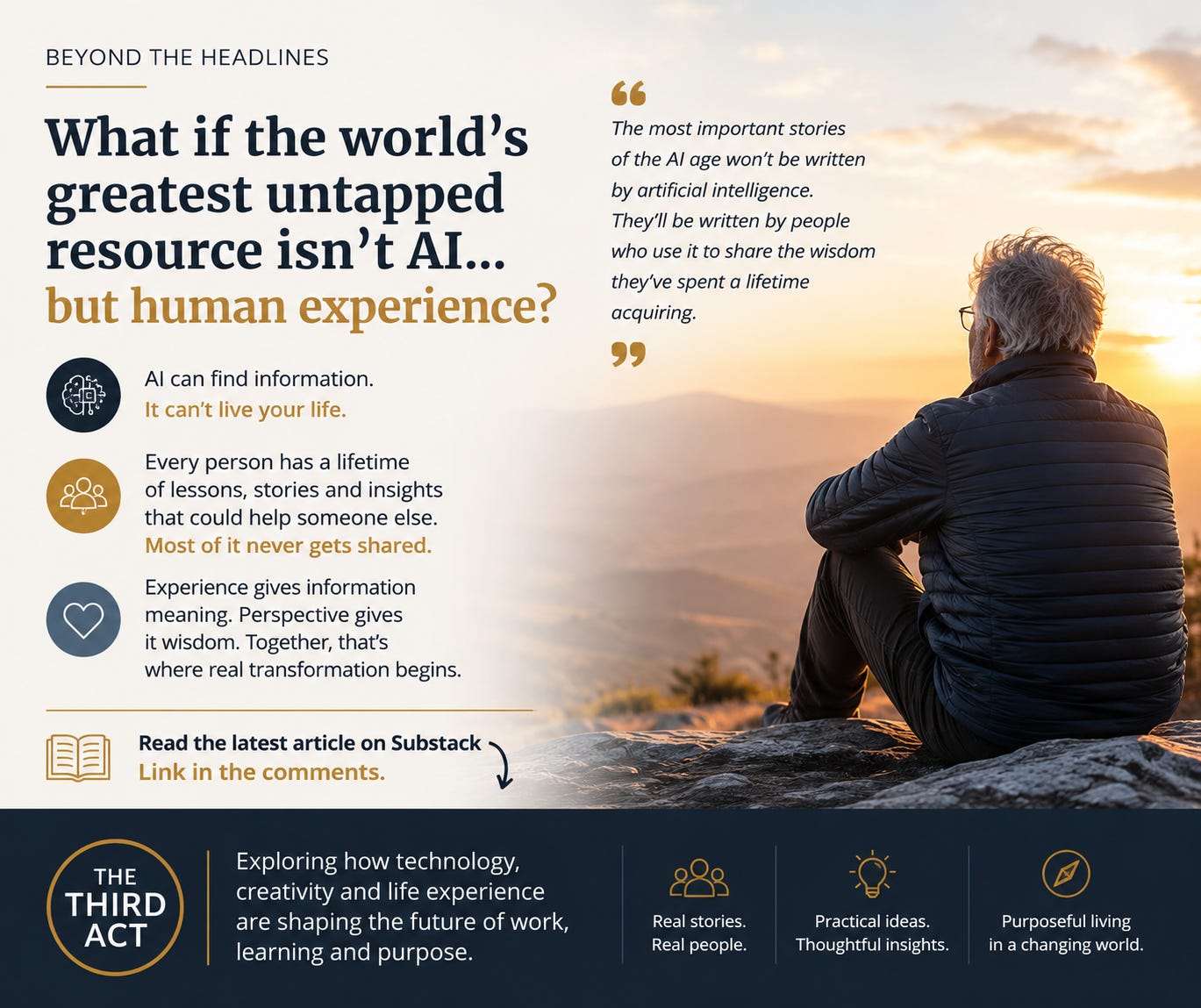
“What if the world’s greatest untapped resource isn’t artificial intelligence, but the experience of ordinary people?”
The response made me realise something.
Perhaps we’ve been asking the wrong question.
For the past few years, almost every conversation about the future has centred on artificial intelligence. How powerful will it become? Which jobs will it replace? How quickly will society change?
These are important questions.
But they overlook something just as valuable.
People.
Every day, millions of people search the internet for answers.
How do I start a business?
How do I cope with retirement?
How do I manage my health?
How do I become more creative?
The information is already there.
Search engines can find it.
AI can explain it.
Books have been written about it.
Yet many people still feel overwhelmed.
The problem isn’t a lack of information.
The problem is turning information into something useful.
Over the past few months I’ve discovered this for myself.
When I was trying to understand my own health, there wasn’t a shortage of advice. There were hundreds of articles, videos and opinions.
What I needed wasn’t more information.
I needed help making sense of it.
I needed someone—or something—to help organise it, identify the important parts and turn it into a practical plan that made sense for me.
That’s when I realised something.
Information has become abundant.
Understanding hasn’t.
The same is true for knowledge.
Think about the people around you.
The nurse with thirty years of experience.
The engineer who spent decades solving problems.
The teacher who helped hundreds of children.
The small business owner who survived difficult times.
The artist who discovered creativity later in life.
Most of them will never write a book.
Many won’t create a podcast.
Some don’t even believe they have anything worth sharing.
I think they’re wrong.
Experience is one of the world’s most valuable forms of knowledge because it has already been tested in real life.
Artificial intelligence can access enormous amounts of information.
What it cannot do is live thirty years of your life.
It cannot experience your successes.
It cannot learn your lessons.
It cannot replace your judgement.
As we move towards the end of this decade, I believe the people who thrive won’t simply be those who know how to use AI.
They’ll be the people who combine AI with experience, curiosity and good judgement.
Technology can help us communicate.
It can’t replace what we’ve learned by living.
Perhaps that’s the opportunity.
Not to compete with AI.
But to use it to help more people find their voice.
Because somewhere today there’s a retired nurse with wisdom that could comfort thousands.
A former engineer with lessons worth passing on.
A parent whose experiences could help another family.
An artist who discovered it’s never too late to create.
Their knowledge already exists.
It just hasn’t been shared yet.
Maybe the world’s greatest untapped resource isn’t artificial intelligence.
Maybe it’s millions of ordinary people who have extraordinary experience and simply need better tools to share it.
And perhaps that’s one of the most important conversations we’ll have over the next decade.
💬 Join the Conversation
I’d love to hear what you think.
Do you believe experience is becoming more valuable in the age of AI?
What knowledge have you gained through life that could help someone else?
Leave a comment below and let’s continue the conversation.
If you enjoyed this article, please share it with someone who might find it useful.
📖 Continue Reading
This article introduces an idea.
The companion article explores it in much greater depth.
In the companion edition you’ll discover:
Why information is becoming abundant but judgement is becoming more valuable.
Why asking better questions may become one of the most important skills of the AI era.
How I’ve been using AI as a thinking partner rather than simply a writing tool.
Why I believe ordinary people will play an important role in shaping the next decade.
A first look at the Editorial Challenge and how it could help people turn experience into something worth sharing.
Subscribe free to The Third Act to read the companion article and receive future editions directly in your inbox
About The Third Act
The Third Act explores how technology, creativity and life experience are reshaping the future of work, learning and purpose.
We believe everyone has knowledge worth sharing.
Our mission is to help people turn experience into something that informs, inspires and helps others.